1. Introduction: The End of the Checkout Line (and the Privacy We Knew)
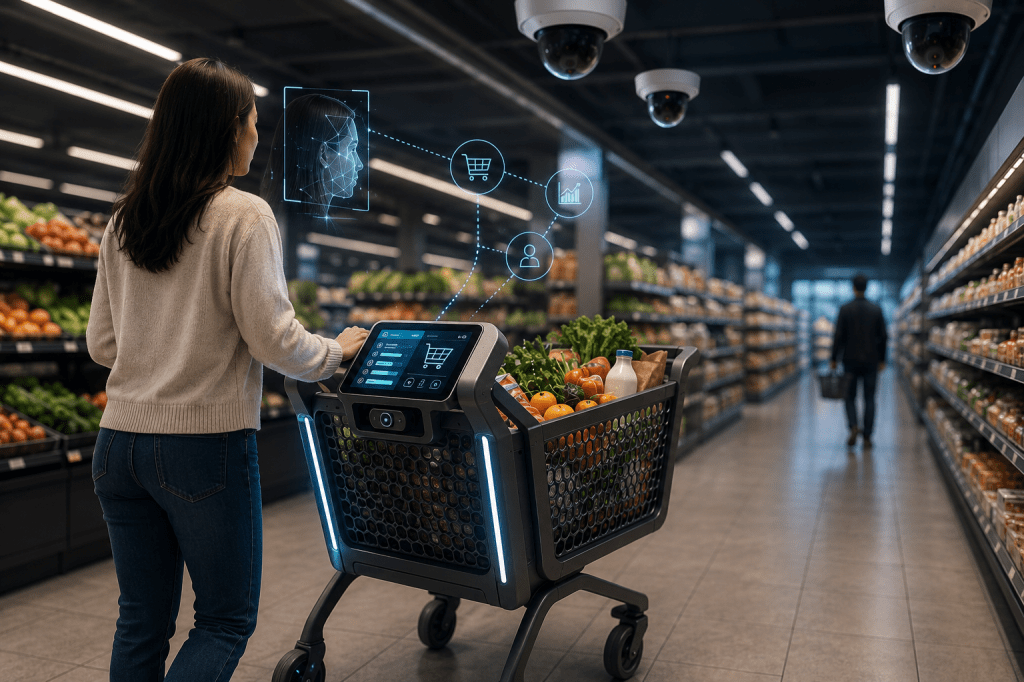
For the modern shopper, the appeal of the “smart cart” is sold as a liberation from the drudgery of the checkout line. Major retailers like Kroger, ShopRite, and Whole Foods are increasingly deploying these sensor-laden surveillance pods to provide a “seamless” shopping experience. You scan your items as you go, watch the subtotal climb on an integrated iPad, and walk out the door—the ultimate friction-free transaction.
However, beneath this veneer of convenience lies a fundamental restructuring of the retail landscape. What appears to be a helpful tool for the time-crunched consumer is, in reality, a sophisticated instrument of observation. As we sleepwalk into the “scan-and-go” era, the local supermarket is being converted into a high-tech surveillance zone. We have to ask: Is this technology designed to serve the public, or is it designed to harvest us?
2. Takeaway 1: Your Cart is a Rolling Surveillance Hub
The architecture of the modern AI shopping cart is a marvel of sensor integration, and the architect behind most of what you see today is Instacart. These carts are not just containers; they are mobile data-collection units equipped with internal scales, high-fidelity scanners, and a perimeter of cameras monitoring the front, back, and sides.
This hardware records every aisle you walk down and every single item you pick up. It is hyper-sensitive, documenting even a “flicker of movement”—including the moments you spend simply looking at a product before putting it back. It represents a shift from a tool that carries groceries to a device that meticulously logs your physical behavior in real-time.
“This thing basically knows every aisle you walk down, every single item you pick up, and it’s also keeping track of your trends… it’s recording every single thing that you do inside of a supermarket.”
3. Takeaway 2: The End of “Innocent Until Proven Guilty”
The AI does not care about your intentions; it only cares about its algorithms.
Consider the shopper at Walmart at 10:00 PM, scanning protein shakes for the week. Because she placed the heavy bottles directly into her cart rather than a bag, the AI flagged her movement as “suspicious.” Instantly, the screen flashed an “associate on the way” alert, effectively freezing her in place until a human employee could review the video of her “crime.”
The police are going to believe the computer over you; that is a fact.
This creates a chilling power dynamic. When you “fight the computer,” you are fighting a system that stores your facial data and shopping history. If the software gets it wrong—which it occasionally does—you face more than just an awkward moment in the aisle.
While AI surveillance inside stores is largely outside your control, protecting your own home is not. A modern AI-powered wireless security camera lets you monitor your property with intelligent motion detection, instant alerts, and 24/7 visibility.
Recommended Product: Security Camera Wireless Outdoor
https://www.amazon.com/dp/B0FDBBW27M?ref=t_ac_view_request_product_image&campaignId=amzn1.campaign.3PB5J93S82RCQ&linkCode=tr1&tag=ark3330a-20&linkId=amzn1.campaign.3PB5J93S82RCQ_1782362390909
The “Shared Trespass” is another growing concern.
If you are flagged for “petty theft” by an error-prone AI, you aren’t just banned from one store. Retailers like Walmart, Target, Home Depot, Lowe’s, and Aldi have the capability to share trespass data. One algorithmic mistake could potentially affect your ability to shop across multiple retailers.
4. Takeaway 3: You Are the Product (The Data is More Valuable Than the Groceries)
The rollout of these carts is less about labor efficiency and more about the data economy. Look at Walmart’s acquisition of Vizio; they didn’t buy a TV company simply to sell televisions. They acquired a platform capable of collecting valuable consumer behavior data.
In this model, the hardware—whether it’s a TV or a smart grocery cart—can become a gateway for gathering information about customer habits.
They are willing to lose money on hardware because the data harvested from consumer behavior is often worth far more than the products themselves. By tracking shopping habits and movement, retailers gain unprecedented insight into purchasing behavior.
As more smart devices become connected, your home network becomes just as important as your physical security. Upgrading to a Wi-Fi 7 Mesh Router provides stronger security, faster speeds, and reliable coverage for all your connected devices.
Recommended Product: Secure Wi-Fi 7 Mesh Router
https://www.amazon.com/dp/B0D526GSYY?ref=t_ac_view_request_product_image&campaignId=amzn1.campaign.2Y0KQSZRPPKA7&linkCode=tr1&tag=ark3330a-20&linkId=amzn1.campaign.2Y0KQSZRPPKA7_1782362861421
“This is the difference between a community hub where you know your grocer and a data-driven retail environment where every customer interaction becomes valuable information.”
Protect Your Privacy in an AI World
As AI surveillance becomes more common in retail stores, many consumers are also upgrading the security and privacy of their own homes. While you can’t control how retailers collect data, you can take steps to protect your own property, internet connection, and smart devices.
🔒 AI-Powered Home Security Camera
Monitor your home with intelligent motion detection, night vision, and instant mobile alerts.
Security Camera Wireless Outdoor
https://www.amazon.com/dp/B0FDBBW27M?ref=t_ac_view_request_product_image&campaignId=amzn1.campaign.3PB5J93S82RCQ&linkCode=tr1&tag=ark3330a-20&linkId=amzn1.campaign.3PB5J93S82RCQ_1782362390909
📶 Secure Wi-Fi 7 Mesh Router
Keep every connected device protected while enjoying faster, more reliable Wi-Fi coverage throughout your home.
Secure Wi-Fi 7 Mesh Router for Connected Devices
https://www.amazon.com/dp/B0D526GSYY?ref=t_ac_view_request_product_image&campaignId=amzn1.campaign.2Y0KQSZRPPKA7&linkCode=tr1&tag=ark3330a-20&linkId=amzn1.campaign.2Y0KQSZRPPKA7_1782362861421
🎥 Professional AI CCTV Surveillance Kit
Protect your home or business with AI-powered cameras featuring intelligent detection, continuous recording, and remote monitoring.
Professional AI CCTV Surveillance Kit for Home or Business
https://www.amazon.com/dp/B0B8HLXC8Y?ref=t_ac_view_request_product_image&campaignId=amzn1.campaign.AMV8LKUS2PCK&linkCode=tr1&tag=ark3330a-20&linkId=amzn1.campaign.AMV8LKUS2PCK_1782362998897
Disclosure: As an Amazon Associate, I earn from qualifying purchases. This comes at no extra cost to you and helps support the creation of content like this.
5. Takeaway 4: The End of Human Connection and Labor
The AI revolution is systematically reducing human interaction inside grocery stores. Between smart carts and autonomous robots monitoring inventory, many routine tasks once handled by employees are becoming automated.
Even the technology’s impressive efficiency comes at a cost. You can throw items into the cart and the system still identifies them accurately, but that convenience replaces much of the human interaction that once made neighborhood grocery stores feel like community spaces.
6. Takeaway 5: Personalized Manipulation and Dynamic Pricing
The most controversial possibility of smart cart technology is the move toward personalized pricing. Instead of fixed prices displayed on shelves, future systems could potentially tailor promotions and offers based on shopping history and loyalty data.
Using purchase history and customer profiles, retailers could determine which discounts are most likely to influence buying decisions. While this can create more relevant offers, it also raises important questions about fairness and consumer privacy.
7. Conclusion: The Industrial Revolution of Our Time
We are witnessing a technological shift comparable to the Industrial Revolution, but unfolding at digital speed. Massive investments in AI, cloud computing, and data centers are accelerating the transformation of retail.
As grocery stores become increasingly automated, consumers must balance convenience with privacy. Saving a few minutes at checkout may come with trade-offs involving personal data, behavioral tracking, and reduced human interaction.
The good news is that while you can’t stop AI from evolving, you can make informed choices about protecting your own digital life. Investing in secure home technology, strengthening your network, and understanding how your data is collected are practical steps toward maintaining greater control over your privacy.
When you head out for your next grocery run, will you embrace the smart cart—or choose more traditional methods to limit how much data you leave behind?







Leave a comment