
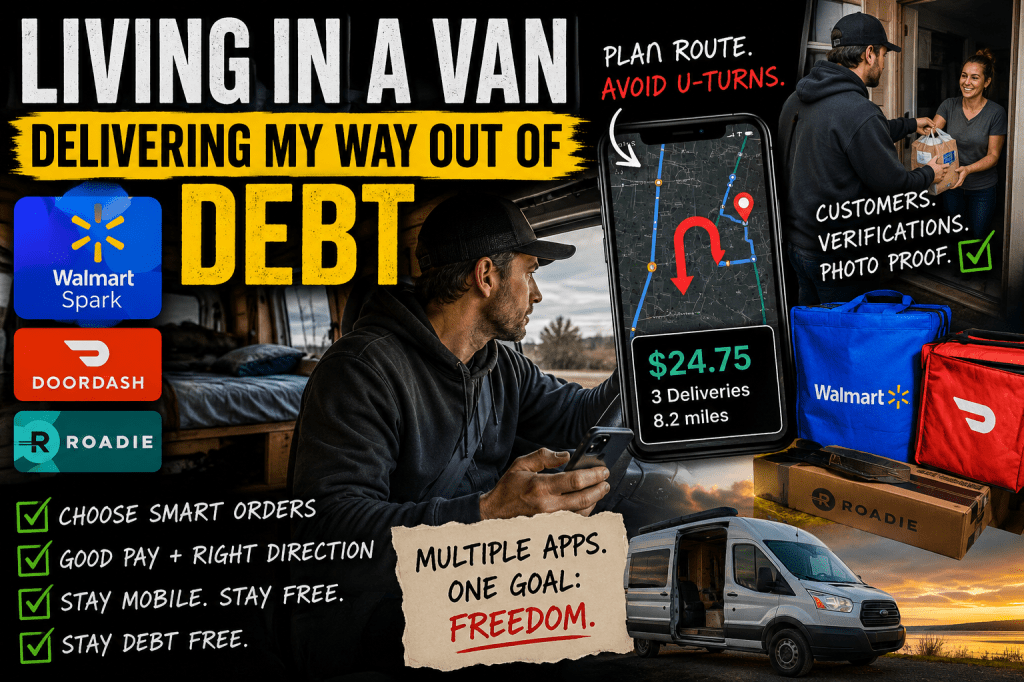
For the modern nomad, the dream of van life often collides head-on with the cold reality of a balance sheet. We see the curated sunsets on social media, but rarely do we see the frantic tap-and-slide of a driver “Sparking” for Walmart or “Dashing” for a quick tenner while parked illegally in an “unauthorized” zone. For those of us living on the road to pay off debt, the van is less of a bohemian escape and more of a high-stakes logistics hub. Every mile is a calculation, and every notification from a gig app is a heartbeat of potential or a missed opportunity.
Balancing full-time gig work with life in a van requires a specific kind of mental gymnastics. You aren’t just a delivery driver; you are a warehouse manager, a navigator, and a small business owner navigating a landscape of one-way streets and fickle algorithms. From picking up “Roadie” contracts to managing the physical fatigue of urban maneuvers, the hustle is relentless. It’s a life defined by the constant search for the next payout that justifies the fuel in the tank.
Directional Income: Strategy Over Pay Rate
In the gig economy, the gross pay of an order is often a secondary metric. For a van dweller, the primary KPI is “directional income.” This is the survival tactic of accepting orders not based on the highest dollar amount but on where the delivery ends. When your home is your vehicle, moving for the sake of moving is a financial drain. However, if an 18-mile delivery pays $33—a solid nearly $2-per-mile ratio—and it terminates in the exact neighborhood where you intended to park for the night, that order is essentially subsidizing your lifestyle.
This strategy transforms the driver from a passive participant into a tactical logistics coordinator. By only taking work that aligns with their personal travel, nomads can negate the high cost of fuel and wear-and-tear on their primary residence. It’s about making the miles you were going to drive anyway work for you.
“It’ll put me in a direction that I kind of sort of want to go anyway… it works out.”

The “Surge” Gambling Problem
Timing is the ultimate gamble for the mobile gig worker. There is a palpable anxiety in the “surge” game: do you wait for the app to bump the pay as the deadline nears, or do you lock it in now? The source of this tension isn’t just the algorithm; it’s the physical competition sitting in the car next to you in the parking lot. In the gig world, you are fighting real people for limited resources.
This competitive pressure often forces a “bird in the hand” mentality. For instance, a driver might grab two orders for a combined $18 rather than waiting for a surge, simply because “somebody else is in the area” and already snatched up two others. Losing a “drop” entirely is a much greater risk than taking a lower payout. In this economy, speed and situational awareness are the only ways to ensure you aren’t left with an empty itinerary.
The Absurdity of Modern Logistics
The daily grind often reveals the bizarre inefficiencies of corporate logistics. There is a profound disconnect between the “lean” hustle of a van dweller and the wasteful reality of retail packaging. This absurdity is peaked when a driver navigates the tight confines of a one-way street, fighting the bulk of a van, only to deliver a single item encased in layers of plastic and cardboard.
One specific instance involved a single beverage delivery that was so “very overpackaged” it bordered on the comical. For a driver who meticulously manages every inch of space in their van, seeing such excessive waste for a single drink is a reminder of the practical disconnect between the gig worker’s reality and the corporate delivery machine.
“This is just one drink; it’s very excessive.”
The Van as a Literal Mobile Office
Living in a van doesn’t just blur the line between personal space and professional requirements—it erases it. The vehicle is a home, a pantry, and a mobile office, leading to unique logistical “glitches.” This was perfectly illustrated during a warehouse pickup where a sign read “contractors must clock in.” The professional requirement to “clock in” and provide identification forced the driver to jog back to the van to retrieve their ID.
This interaction highlights the reality that a nomad is never truly “off the clock.” Because the workplace is home, the professional tools—IDs, charging cables, and delivery bags—are woven into the fabric of their domestic life. There is no separation; the van must always be ready to transition from a bedroom to a commercial transport vehicle in the seconds it takes for a notification to pop up.
The “Invisible” Physical Toll
While “driving” sounds sedentary, the physical reality of maneuvering a large van through urban landscapes is exhausting. The mental load of managing one-way streets and the constant necessity of making U-turns is significant. A driver might find themselves frustrated by a 14-mile delivery that requires 22 minutes of intense navigation and “making U-turns all day long” just to find the right entrance.
The weight of the cargo adds another layer to this physical toll. There is a distinct sense of relief when an 18-mile, $33 delivery turns out to be “not heavy at all.” The physical navigation of the vehicle, combined with the manual labor of the drop-offs, creates a cumulative fatigue that the app’s “total pay” figure never quite accounts for.
“This is a long one, 14 miles, 22 minutes. Have to go down and make another U-turn.”
Things which I love:
Garmin inReach Mini 2 Satellite Communicator: https://amzn.to/4w6pn5w
Garmin fēnix 8 AMOLED Sapphire Titanium GPS Smartwatch:
GoPro HERO13 Black Action Camera:
Jackery Explorer 1000 v2 Portable Power Station:
Money Belt for Travel: https://amzn.to/4akewg8
Conclusion: The Cost of the Debt-Free Dream
The life of a mobile gig worker is a masterclass in logistical flexibility. By turning a van into a tool for debt repayment, individuals can achieve financial freedom at the cost of constant motion and competitive stress. It is a world where success is measured in directional miles and the ability to pivot at a moment’s notice.
As more workers opt for the flexibility of the road over the stability of the office, we have to wonder about the long-term sustainability of this trade-off. It’s a life of high stakes and high rewards, but it begs a fundamental question: Would you trade the predictability of a 9-to-5 for the “U-turn” life of a mobile gig worker?





Leave a comment