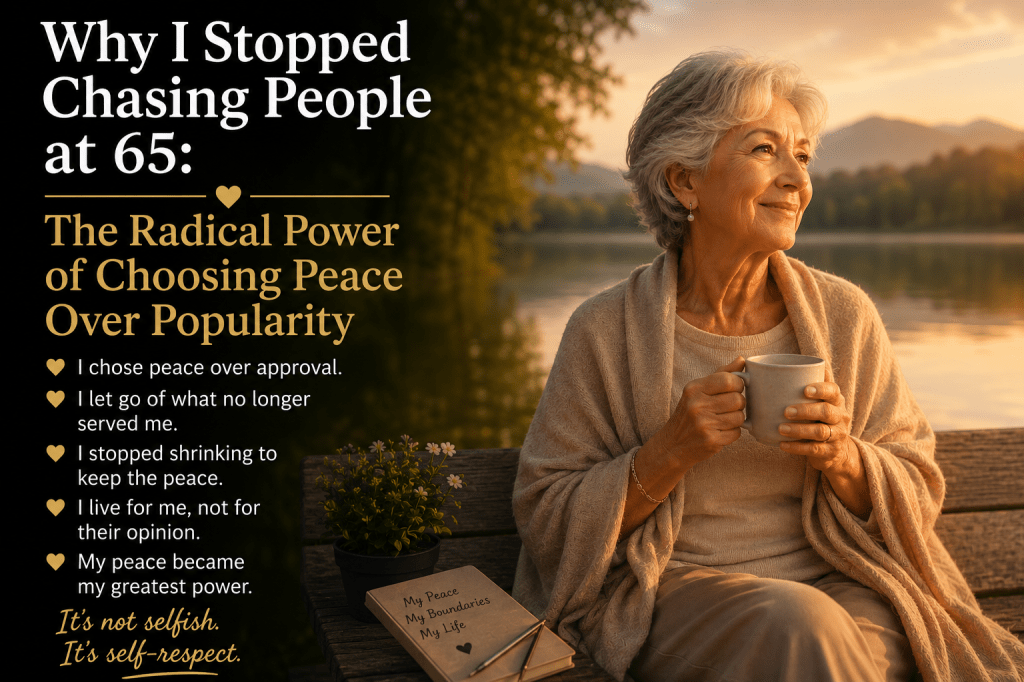
I have been thinking about this quite a bit recently: the strange realization that, at 65, I no longer have any desire to expand my social circle. In a cultural climate that treats networking, follower counts, and constant connectivity as the ultimate markers of a life well-lived, wanting fewer people in one’s life might sound counterintuitive, perhaps even regressive. Yet, as I navigate this “second act,” I find myself shifting away from the exhausting pursuit of quantity in favor of a much rarer currency: quality.
This isn’t a transition into isolation, but rather a move toward meaning. There is a quiet but pervasive movement happening among those of us in this stage of life—a shared, unspoken understanding that the “noise” of modern existence has become a weight we are no longer willing to carry. We aren’t becoming antisocial; we are becoming intentional.
The Rarity of Real Conversation
In our hyper-connected world, most daily interactions have become transactional and profoundly distracted. We navigate a landscape of “small talk” that feels more like a placeholder for silence than a bridge to connection. We cycle through the same tired loops—the weather, the latest news cycle, or the ephemeral “social media nonsense” that dominates the digital age. These are interactions where people don’t actually listen; they merely wait for their turn to speak.
The tragedy of this surface-level chatter is that it leaves us feeling more alone than silence ever could. True richness is found in the conversations that dive deeper—the dialogues concerning retirement, purpose, health, regrets, happiness, and, perhaps most importantly, fear. These are the topics that resonate long after the coffee has gone cold.
“Most people don’t really listen anymore; they wait for their turn to speak. You can almost see it happening—you’re halfway through talking, and they’re already preparing what they’re going to say next.”
When we stop chasing the crowd, we create space for these deeper exchanges. We move past the digital ephemera and the “rubbish” of celebrity culture to engage in something that feels real.

Age as “Permission” to Be Honest
There is a profound psychological relief that comes with age: the granting of “permission” to stop pretending. For decades, many of us felt the cultural pressure to be “always on”—to be out, involved, and perpetually connected. But at some point, the realization hits that this performance is energy-draining.
Choosing a walk in the woods with the dogs or my wife, or a focused session at the gym, isn’t a sign of withdrawal. It is an act of honesty. We finally have the freedom to admit that a proper, singular chat is infinitely more valuable than hours spent making superficial talk in a crowded room. We are no longer afraid to prioritize the environments that actually restore us. This isn’t about being miserable or antisocial; it’s about finally honoring our own energy.
Trading Performance for Authenticity
Youth and midlife are often characterized by a “performance”—a competitive effort to appear more successful, more confident, and more important than we actually feel. We spend years trying to “win” conversations or project a polished image of a perfect life.
However, one of the most significant shifts at 65 is the development of a refined “bullshit detector.” The older I get, the quicker I can spot a performance, and frankly, the more exhausting it becomes to witness. I have lost interest in the image; I am only interested in the person. There is something remarkably refreshing about someone who has the courage to say, “I’m struggling a bit,” rather than maintaining a facade. When the need to impress others falls away, authenticity becomes the only thing worth pursuing. In these quieter, honest conversations, the competitive edge vanishes, leaving room for genuine connection.

Becoming the Architect of Your Own Peace
To thrive in this stage of life, one must become a highly protective gatekeeper of their own peace. This is a necessary evolution. For years, our “first act” was defined by the chaos of the external world—deadlines, career stress, noise, and the heavy weight of professional and family responsibilities. We have paid our dues to the cult of productivity.
Now, peace has become our most valuable asset. Being the architect of your own peace means intentionally declining the drama, the chronic negativity, and the “fake relationships” that offer no real substance. It is a transition from “chasing more” to “choosing better.” When you curate a life that is calm and grounded, you become naturally selective about who is allowed to enter that space.
“Once you start building a calmer life for yourself, you become careful about who gets access to it.”

Redefining Success in the Second Act
We are witnessing a massive redefinition of what it means to be successful. We are moving away from the “popularity” model of our younger years and toward a model of “richness.” In this second act, success isn’t measured by a crowded calendar or a wide social circle; it is measured by feeling understood.
Real richness is found in a specific, curated list of markers: meaningful conversations, genuine people, calm environments, and radical honesty. This shift is one of the unexpected gifts of getting older. It is a healthier, more grounded way to exist because life is simply too short to be surrounded by noise that signifies nothing.
As you reflect on your own life and the social circles you inhabit, ask yourself: Which “noise” are you finally ready to let go of to make room for a connection that actually feels real?






Leave a comment