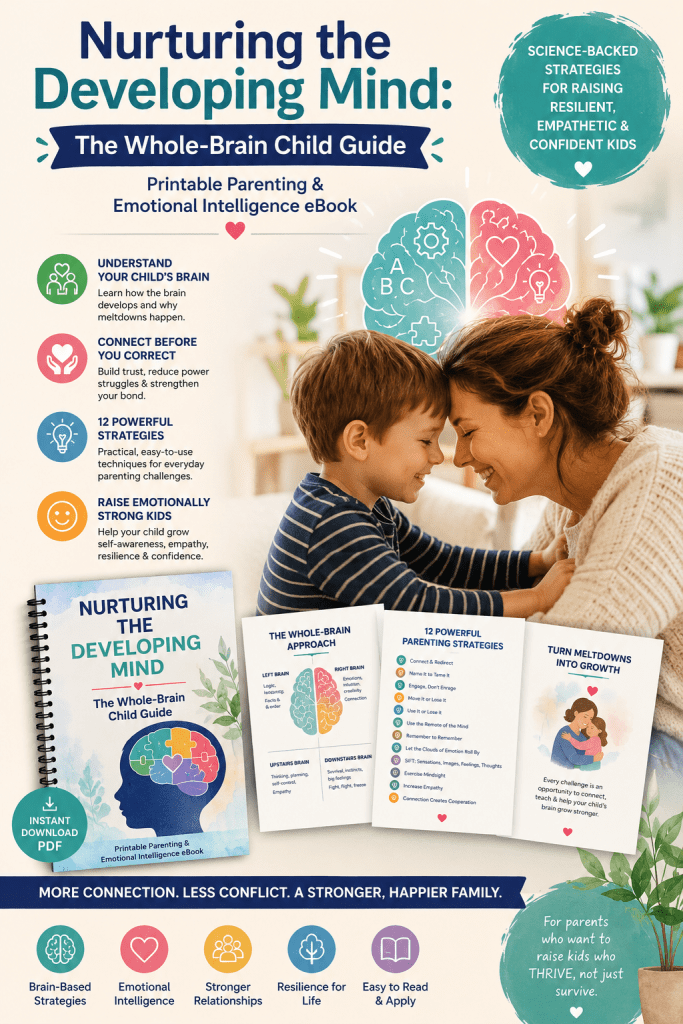
We’ve all been there: the “quesadilla tantrum. “You serve lunch, and because you cut the tortilla into triangles instead of squares, your toddler collapses as if the world has ended. In those moments, most of us shift into “survival mode”—that exhausted, reactive state where the only goal is to stop the screaming so we can make it to nap time.
But here’s the thing that changed everything for me: these moments of chaos aren’t just hurdles to clear. They are actually “clinical windows”—precious opportunities to shape your child’s brain architecture. Because the brain is “plastic” (moldable), our interactions act as the primary tool for “rewiring” it for resilience. We can move from just surviving the day to helping our kids thrive by understanding the biological “why” behind the mess. For instance, in that quesadilla moment, instead of a “command and demand” threat, we can use the “Engage, Don’t Enrage” strategy. By simply negotiating—”How many bites of the triangle is fair?”—you bypass the fight-or-flight response and invite their higher-order thinking back into the room.
1. Your Child’s “Upstairs Brain” is Under Construction (Literally)
To understand our kids, we have to look at the brain’s vertical axis. Think of it like a two-story house. The “downstairs brain” is primitive and reactive; it’s responsible for basic functions like breathing and the “fight, flight, or freeze” response. The “upstairs brain” is the sophisticated part—the home of decision-making, empathy, and self-control.
Here is the reality that helps me stay patient: the upstairs brain is a literal construction site until a person is in their mid-twenties. When your child flips their lid, it isn’t a calculated act of defiance; it’s a “downstairs hijack.” In the downstairs brain, a structure called the amygdala acts as a “baby gate.” In high-stress moments, that gate slams shut, blocking the staircase and leaving the rational upstairs brain temporarily offline.
Expecting a child to be “rational” during a tantrum is biologically impossible. Their brain simply hasn’t finished building the staircase that connects their impulses to their logic. Knowing this allows us to trade our frustration for empathy.
2. Connect Before You Redirect (Right Brain to Right Brain)
The brain also has a horizontal axis: the logical, verbal left and the emotional, non-verbal right. The left brain loves order and lists, while the right brain is experiential and holistic. In young children (especially under age three), the right brain is developmentally dominant.
In high-emotion moments, the right brain takes over, and the left brain goes “offline.” If you try to use logic—”You just had a snack; you can’t be hungry!”—you are using a verbal left-brain tool on a non-verbal right-brain problem. This usually makes the child scream louder because they don’t feel “felt.”
The strategy here is Connect and Redirect. You must connect right-to-right first through empathy, a soothing tone, and physical touch.
“Connect emotionally first. Then redirect with logic. Connection activates their right hemisphere so it calms down enough for the left to come back online.”
Once the child feels heard and is in a more receptive state, you can bring in the left-brain lessons and discipline.
3. Name It to Tame It (The Power of Storytelling)
When a child experiences something scary, the memory often gets “stuck” in the right brain as a chaotic, wordless emotion. We saw this with a two-year-old named Marco, who was in a car accident. He kept repeating “Eea woo woo”—his words for his babysitter Sophia (“Eea”) and the ambulance siren (“woo woo”).
While we might be tempted to “fast-forward and forget” by distracting them with ice cream, this leaves the child confused. Instead, the Name It to Tame It strategy helps the child integrate the experience. Marco’s mother, Marianna, didn’t just tell the story once; she helped him retell it over and over again throughout the week. By using the left brain to put words and sequence to the right brain’s raw feelings, the experience becomes a manageable part of their past rather than an active source of terror.
4. Move the Body, Save the Mind (“Move It or Lose It”)
Research shows that bodily movement directly affects brain chemistry. Emotions often start as physical responses—clenched fists, a racing heart, or a nervous stomach. When a child is stuck in a downstairs hijack, talking often isn’t enough to “unstick” them.
The strategy Move It or Lose It suggests that physical movement can pave the way for brain integration to return. If you sense your child is about to lose it, help them move it. Try these specific “brain-movers”:
- Wall pushes or crab crawls in the living room.
- Jumping on a trampoline or running up and down the stairs five times.
- Tossing a ball back and forth.
- Deep breathing or “swallowing a bubble.”
As the saying goes, “Moving the body to avoid losing the mind.” Physical activity shifts the nervous system out of a “freeze” state, allowing the upstairs brain to re-engage.
5. Feelings are Like Clouds (Teaching “Mindsight”)
One of the most powerful tools we can give our kids is “mindsight”—the ability to understand their own minds. A key part of this is the SIFT tool, helping kids pay attention to Sensations, Images, Feelings, and Thoughts.
However, we must be careful not to use “naming” as a way to rush back to logic. To truly integrate, we should follow the 95/5 Rule: spend 95% of your time just being with the physical sensation (the “rock in the stomach” or “tight throat”) and only 5% naming it. We want to teach them that feelings are like clouds—they come and go—but they are not the child’s identity.
In the “Wheel of Awareness,” your child is the hub (the place of calm center), while feelings are just things on the rim that roll by. Helping a child notice where they feel emotions in their body builds an intuitive self-awareness that prevents them from being over-identified with their anger or fear.
Conclusion: From Chaos to Connection
The goal of whole-brain parenting is to keep our children in the “River of Well-being.” On one side is the bank of chaos (out of control emotions); on the other is the bank of rigidity (no flexibility). Integration is the flow in the middle.
Every time you choose connection over a power struggle, you are helping your child build a stronger, more integrated brain. You are moving from “command and demand” to “engage and relate.”
Next time your child “flips their lid,” will you see a behavioral problem to be suppressed, or a brain-building opportunity to be seized?






Leave a comment