Most founders are currently coding themselves into a hole. They treat every line of code as an asset, but the data proves that in the $0 to $10K MRR stage, unvalidated code is actually a liability. The romanticized “build it and they will come” strategy is a recipe for crickets and capital burn.
An analysis of over 300 SaaS founder journeys reveals a definitive pattern: the path to $10K MRR is not paved with engineering brilliance but with systematic validation and specific, repeatable distribution protocols. If you want to move from zero to revenue, you must stop “moment-seeking” and start building an architecture for predictable growth.
TAKEAWAY 1: The “Rule of 20” and the 3-Week Production Deadline
The primary pattern of failure for founders stuck at $0 MRR is building everything from scratch before talking to a single human. Successful founders treat engineering as the final step of validation, not the first. They adhere to the “Rule of 20”: conducting a minimum of 20 in-depth conversations before the first line of code is written.
These conversations must be a non-negotiable checklist focusing on the following:
- Validated Pain: Does the problem actually disrupt their workflow?
- Current Solutions: What are they currently paying for (or hacking together) to solve it?
- Specific Willingness to Pay: Will they commit to a price point before the product exists?
Furthermore, successful founders don’t waste months on a “perfect” build. They use boilerplates to reach production in 2–3 weeks. While failures “build from scratch,” successes “ship to validate.”
“The pattern is consistent: successful founders validate through 20+ customer conversations before building, asking about pain points, current solutions, and specific willingness to pay.” — Analysis of 300+ SaaS founder case studies (MeThyck)

TAKEAWAY 2: The Two-Week “Multi-Directory” Protocol
Relying on a single-day viral spike on Product Hunt is a strategic trap. The data compares the two approaches clearly: a single-day launch typically yields 5–15 signups, whereas a systematic, two-week “Multi-Directory” protocol regularly drives 80–150 signups.
Stop “moment-seeking” and start “momentum-building.” You must distribute your launch across 20+ directories and communities over a 14-day window, including:
- Product Hunt
- BetaList
- launching.io
- SaaSHub
- Indie Hacker communities
By treating the launch as a systematic event rather than a 24-hour sprint, you create a diversified lead floor rather than a fragile, one-time spike.

TAKEAWAY 3: Why Manual Onboarding is Your Greatest Competitive Advantage
Premature automation is where product insights go to die. Founders who scale to $10K MRR often choose to manually onboard their first 50 customers. While this “doesn’t scale,” it creates a high-fidelity feedback loop that automation hides.
When you manually walk a user through your product, you see exactly where the UI causes friction and where the value proposition fails to land. Scaling toward $10K MRR requires this level of intimacy; once you have 50 users who have been “hand-held” to success, you have the data necessary to automate a process that actually works.

TAKEAWAY 4: The Economics of SaaS Partnerships as Compounding Fuel
In B2B SaaS, partnerships are not just transactions—they are your compounding growth fuel. However, professional publishers and partners will only look at you if your architecture aligns with B2B standards, which differ significantly from retail e-commerce.
According to Reditus architecture data, the B2B SaaS partnership standard includes:
- 22.5% Recurring Commission: Paid in Year 1 to incentivize partners with compounding returns (decaying to 14.2% in Year 2).
- 4.2-Month Median CAC Payback: Minimizing upfront cash flow risk compared to paid media.
- 30-90 Day Attribution Window: Essential for the extended decision-making cycles of B2B software.
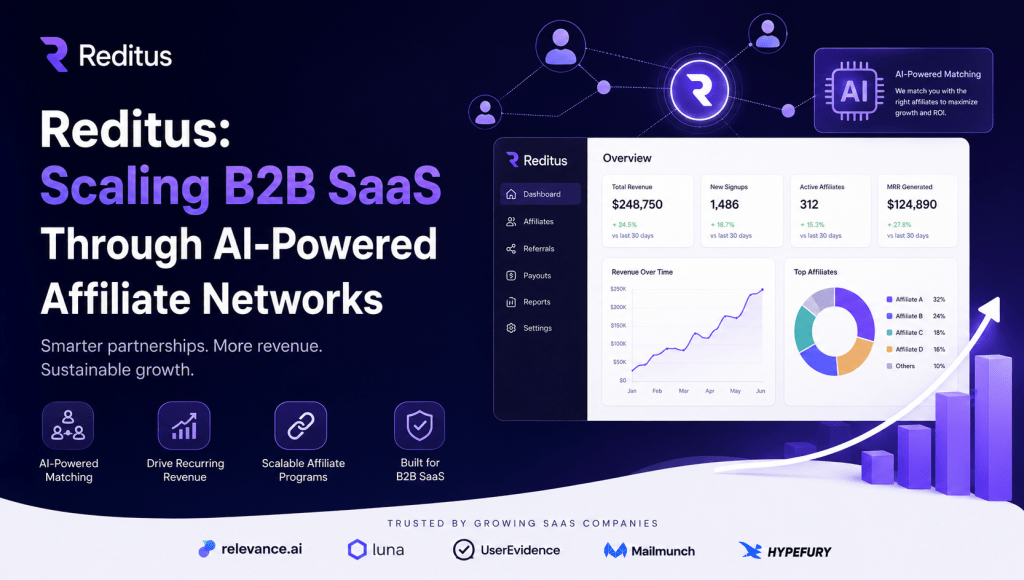
Strategic Note: While platforms like Reditus provide marketplace access to 6,000+ vetted partners, this is often gated for early-stage founders (Scale Up/Enterprise tiers). Until you reach that scale, you must use these metrics to manually recruit partners, proving that your recurring commission is a better bet than a one-time retail fee.
TAKEAWAY 5: SEO is a Day 1 Requirement, Not a Phase 2 Luxury
The most dangerous myth in SaaS is that content can wait until the product is “perfect.” The data proves the opposite: founders stuck at $0 MRR waited months to start content, while successful founders started SEO on Day 1.
By publishing 2–3 posts weekly targeting long-tail, buyer-intent keywords, successful founders see organic traffic driving 40–60% of their signups by month six. This is not just “extra” traffic; it is often more sustainable and effective than your initial launch.
“Focus on validating with real customers first… Then start publishing SEO-friendly content right away; the early organic traffic often outperforms a single-day launch.” — Introduction Lumpy552, SaaS Growth Analysis
CONCLUSION: The Architecture of Predictable Growth
Success in the $0 to $10K MRR journey is not an accident of “shipping fast”—it is the result of shipping the right things into a validated distribution machine. Predictable growth requires moving away from hope-based development toward a playbook of frameworks and patterns.
Is your current roadmap built on 20+ validated customer pain points and a 3-week boilerplate build, or are you just coding toward a “launch day” that may never arrive? Stop investing in more analytics tools and start investing in validation. The data proves the framework works; your only job is to execute it.







Leave a comment