1. The “Book Now” Trap: A Hook into the New Reality of Flying
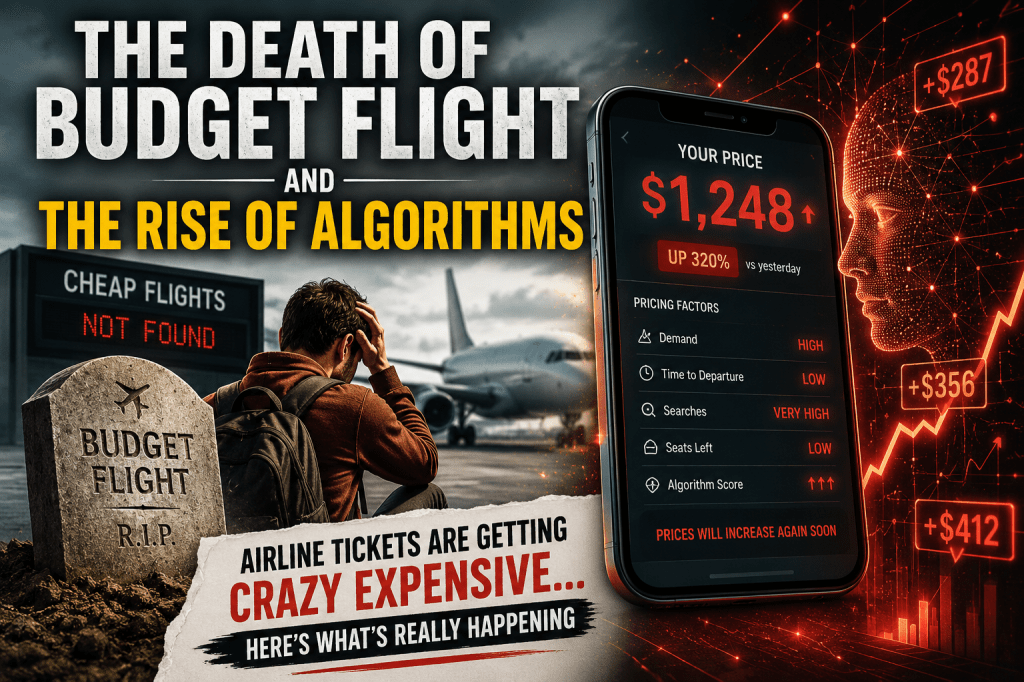
We’ve all been there: You find a flight, the price looks reasonable, and you begin the checkout process with a sense of relief. But just as you’re about to click “purchase,” a popup appears like a digital highwayman. Suddenly, that $340 ticket has morphed into a $550 charge. You’re told prices “fluctuate,” but it feels less like a market correction and more like a shakedown. This isn’t just bad luck or a sudden spike in jet fuel costs; it’s the dawn of a new, aggressive era in aviation.
Airline travel is no longer a matter of simple logistics and overhead. It has transformed into an algorithmic “shadow ecosystem” designed to test the absolute limits of consumer desperation. As ticket prices skyrocket toward astronomical levels, the industry is shifting from a public utility mindset to a high-stakes game of digital surveillance. If you feel like the airlines are watching you, it’s because they are—and they are waiting for the exact moment you’re too tired or too desperate to say no.
2. Algorithmic Surveillance: They Know Why You’re Flying
Delta Airlines recently signaled a shift toward deeper algorithmic pricing, a move that opens a Pandora’s box of privacy concerns. While the airline frames this as “innovation,” the technical reality is disturbing: we are entering a world where your ticket price could be determined by your personal tragedies. Imagine a scenario where a data broker identifies a death in your family by monitoring your browsing history or your phone’s location data. If an algorithm anticipates you need to fly home for a funeral, it can hike the price specifically for you, knowing you’re in a “tight spot” with no room to negotiate.
This surveillance capitalism has reached 30,000 feet, fueled by a shadowy network of data brokers tracking your every digital move. One passenger recently conducted an “experiment” that exposes the shady nature of this tech. While booking a flight to Miami, a popup claimed the price had jumped $200 mid-transaction. When the passenger refused to succumb to this forced “FOMO situation,” went back, and restarted the process, the original lower price miraculously reappeared. It wasn’t a price change; it was an algorithmic test of resolve.
“It’s almost like it fronts you with another price and then front-runs it when you [balk], trying to get you to see which one you’ll go at. It’s almost like a… FOMO situation… I see this in dynamic prices… They just got to get you to execute.”

3. The “Spirit Effect”: Why the Death of Budget Airlines Hits Your Wallet
For years, the “Spirit Effect” served as a crucial check on corporate greed. Even if you never stepped foot on a budget carrier, Spirit’s rock-bottom fares acted as a price floor, forcing legacy carriers like Delta, United, and American to keep their “Main Cabin” prices tethered to reality.
That downward pressure is evaporating. As Spirit has been forced to shutter operations on various routes due to financial hurdles and a lack of political support for their business model, the “budget” threat has been neutralized. On routes where Spirit stopped flying, fares have jumped by more than $100 almost overnight. Without the threat of a low-cost alternative, legacy carriers no longer feel the need to compete. They have established a functional monopoly, signaling to the average traveler that if you can’t afford these astronomical rates, you are no longer the target demographic.

4. The Illusion of Choice: The Commodification of Basic Rights
The pricing tiers currently offered by major carriers have moved past service levels and into a realm of “greed and chaos.” Looking at the “Delta Main” experience, we see the commodification of what used to be basic traveler rights. The corporate calculus is insulting: the physical seat remains identical, but the price fluctuates based on the airline’s ability to gatekeep basic convenience.
- Main Basic ($616): You are a cargo item. No miles, no seat selection, and a high probability of being stuffed into a middle seat at the back of the bus.
- Main Classic ($726): For a $110 premium, you “earn” the right to board in zone six or seven and—in a move that defies logic—the privilege of earning the miles you just paid for.
- Main Extra ($897): You pay nearly $300 more than the basic passenger to sit in the same class of seat, simply for “priority” and a fully refundable ticket.
The absurdity of this system is most visible when you board. Despite these tiered price hikes, planes are often half-empty. Airlines would rather gouge a captive audience to cover the cost of empty seats than lower prices to fill the aircraft.

5. The “Peanut” Economy: Cutting Service to Save Pennies
While ticket prices jump from $250 to $475, airlines are simultaneously nickel-and-diming the onboard experience. Delta recently eliminated snack and water service on flights under 350 miles—routes like San Francisco to Los Angeles.
The math is insulting. Cutting a bag of pretzels and a small water bottle—a cost of roughly $1.50 per passenger—does nothing to justify a $200 fare increase. This is particularly galling for “loyalists” who carry the airline’s branded credit cards and expect a premium experience. Even the “Delta Girlies” are starting to feel the betrayal of a brand that charges an arm and a leg while refusing to provide a cup of water.
“What the [heck] are we doing? We have lost the plot. This is absolute greed and chaos… I feel like if I’m paying for the upgrade to Comfort, I should be at least given a glass of water… You’re really going to cut someone’s bag of Cheez-Its?”
6. Flying as the New “Ultimate Luxury”
We are rapidly approaching a “breaking point” where domestic travel becomes an ultimate luxury, costing one to two full paychecks. In Chicago, a flight to Las Vegas recently clocked in at $1,100—a domestic fare that is simply unsustainable for the average family. In other developed nations, high-speed rail provides a check on airline power, but America’s infrastructure decay and failed railroad systems leave consumers with no alternative.
Instead of a market correction, we are witnessing a cycle of “can-kicking.” When the industry fails, the government steps in with cheap liquidity and bailouts, a phenomenon detailed in the book The Creature from Jekyll Island. This doesn’t fix the broken system; it simply prints more money to plug the holes, pushing the economic fallout onto future generations while ticket prices continue their climb toward the $2,000 mark for simple domestic round trips.

7. Conclusion: The Price of No Alternatives
The airline industry is showing deep cracks. From algorithmic front-running to the elimination of the most basic amenities, the message to the public is clear: travel is becoming a gated community. One of the main issues with our current system is that we tend to try and make sense of “bullshit”—we normalize $1,000 domestic tickets because we feel we have no choice.
But everything can’t continue to rise in price without a total collapse of the surrounding ecosystem. If the average person can no longer afford to fly, what happens to the hotels, the sports venues, and the small businesses that rely on tourism? At what point do we simply decide to stay home, and can the rest of the economy survive the day we finally do?








Leave a comment