Consider two neighbors. Both earn exactly $3,000 per month. One lives in a state of perpetual “financial fog,” unable to cover a $1,000 emergency, while the other sits quietly on a $20,000 cash reserve. What separates them is neither a stroke of investing genius nor a lucrative side hustle. The difference is the system they use to navigate the world.
In the United States, the average savings rate hovers around a meager 3%. In Japan, that figure historically averages 17%. While both cultures face the same human temptations and the same digital marketplaces, one views minimalism as a sophisticated wealth-building system, while the other often mistakes it for a mere “Pinterest aesthetic.” True minimalism is not about owning less for the sake of an empty room; it is a quietly revolutionary act of financial liberation.

1. Radical Financial Simplicity
We have been conditioned to believe that a complex life is a significant one. In the modern financial landscape, we are told that “sophistication” requires dozens of specialized apps, multiple high-yield accounts, and a deck of credit cards optimized for various “rewards.” In reality, complexity is often a mask for chaos. Complexity creates confusion, and confusion kills wealth.
The Japanese ideal is “brutally simple.” While an American might juggle seventeen different finance apps, a Japanese household might manage its entire existence through a Kakeibo—a single, handwritten ledger. This manual awareness creates a connection to capital that digital automation lacks. Automation without awareness is simply “organized blindness.”
“If you can’t explain your financial system to a friend in under 3 minutes, it’s too complicated. Fix that.”
The goal is a system a child could understand: one checking account, one savings account, and one card paid in full monthly. By stripping away the mental overhead of scattered accounts, you gain the clarity necessary to stop overspending before it begins.

2. The Art of Kintsugi for Your Wallet (Repair Over Replace)
We live in a disposable culture designed for obsolescence. We are taught to discard items at the first sign of wear, a habit that compounds into a massive wealth gap over a lifetime. The “repair mindset” is a rebellion against this expensive, disposable cycle.
Consider the “40-year bicycle.” By maintaining the same frame and replacing only tires, chains, and seats, the total investment over four decades is roughly $300. In contrast, following a “5-year replacement cycle” for a $300 bike results in an expenditure of $2,400 over the same period. That is $2,100 lost to the convenience of buying new.
This philosophy extends to every corner of the home. When a $120 coffee maker stops working, the impulse is to browse for a replacement. However, finding an $8 part online and spending twenty minutes on a DIY repair saves $112 and prevents unnecessary waste. Before hitting “buy,” consult a repair guide. Often, a repair costs only 20% to 30% of the replacement price. Over a lifetime, this discipline builds a fortune.

3. Defeating the “Engineered Impulse” (The 24-Hour Rule)
Retailers are masters of engineering urgency. Flash sales, “limited time offers,” and “only 3 left” notifications are precisely calibrated to bypass the rational brain and trigger the impulsive “buy” reflex.
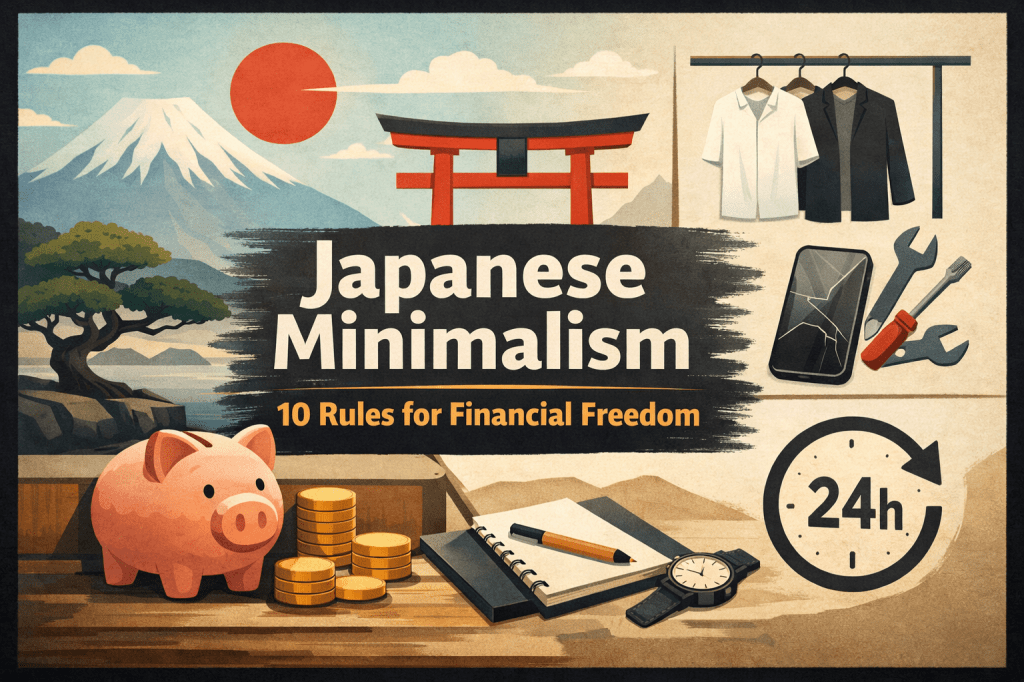
To defend against this, implement a mandatory 24-hour pause for any non-essential purchase over $20. When the impulse strikes, do not add the item to your cart. Instead, take a photo of it or save the link. Then, walk away for one full day.
This pause allows the prefrontal cortex to reclaim control from the emotional centers of the brain. Statistics suggest that 90% of the time, the urgent desire for the object evaporates overnight. Whether it is a gaming console or a designer jacket, the 24-hour rule reinstalls rationality into your financial life.

4. Trading Passive Numbing for Active Rest
There is a profound link between exhaustion and dopamine-seeking spending. We often mistake “passive rest”—scrolling through social media or binge-watching television—for true recovery. In truth, passive rest is a form of numbing that often leaves us feeling groggier and more susceptible to the instant gratification of shopping apps.
Japanese minimalist philosophy emphasizes “active rest”—intentional activities like walking in nature, reading, gardening, or meaningful conversation. While passive rest drains your resolve, active rest restores your energy and sharpens your decision-making.
“Real rest should leave you feeling better, not groggier.”
When you are genuinely restored, you lose the urge to seek “numbing” purchases. Replacing just one hour of screen time with active rest can improve your mental clarity, leading to more purposeful—and fewer—financial choices.

5. Financial Kaizen (The 6-Month Life Audit)
Financial freedom is not a one-time event; it is the result of Kaizen, or continuous improvement. Without regular intervention, waste accumulates in our lives like dust. To prevent this drift, perform a comprehensive life audit every six months—specifically every January and July.
This review is a non-negotiable block of time dedicated to evaluating four specific areas:
- Finances: Are you hitting your savings goals? Are there “zombie” subscriptions to cut?
- Commitments: Which obligations drain your time without providing value?
- Possessions: What has become excess? What can be sold or donated?
- Habits: Which routines are building wealth, and which are eroding it?
Consistency beats cleverness. It is the individual who performs the “boring” semi-annual review who eventually outpaces the “clever” investor who lacks a system.

Conclusion: A Tale of Two Trajectories
The power of these rules lies not in their novelty but in their application as a cohesive system. Consider Sam and Brian, both earning the same income.
Sam treated these rules as a new identity. He simplified his accounts, repaired his gear, and audited his life every January and July. After five years, Sam accumulated $90,000 in investments and is on track to retire at 45. Brian, however, treated these rules as a “checklist” of interesting ideas. He changed nothing, continued to replace worn items immediately, and allowed his finances to remain a cloud of complexity. Brian will likely work until he is 70, wondering where the money went.
Are you currently building a system, or are you just collecting ideas? True wealth is not found in the next “side hustle”; it is found in the quiet discipline of a simplified life. Choose one rule and implement it today. Your future self is waiting.






Leave a comment