1. Introduction: The Year of the “Great Unsubscribe”
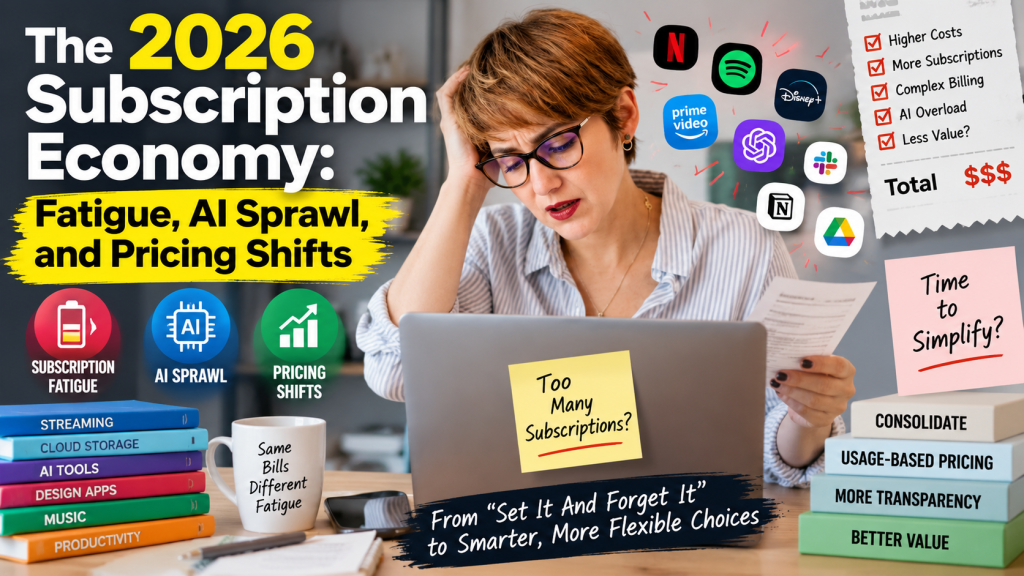
Scan your bank statement today, and you are likely to find a digital graveyard—a silt of recurring charges for “Pro” tiers that failed to launch and “Premium” features you’ve long forgotten. For a decade, the tech sector operated on a simple, predatory premise: the “set it and forget it” model of billing, fueled by consumer inertia. But in 2026, the telemetry suggests a mass revolt.
We have entered the year of the “Great Unsubscribe.” The digital bill has come due, and the frictionless era of the recurring charge has finally met the hard wall of consumer intentionality. The data is unequivocal: 47% of consumers canceled a subscription in 2026, a massive leap from the 31% recorded just two years prior. We have stopped passively paying; we are actively pruning.
2. The $187 Perception Gap: Why Your Bank Account is Leaking
Auto-pay is the tech industry’s favorite anesthetic, but in 2026, the numbness is wearing off. There is a profound psychological disconnect between what we believe we spend and the reality of our “leaking” bank accounts.
The Invisible $273 Monthly Bill The math problem driving subscription fatigue is stark: the average individual estimates their monthly digital spend at a mere $86. The reality? The average U.S. household is currently bleeding $273 per month across 8.2 active services. Perhaps most telling is that 90% of consumers fundamentally underestimate this total—a gap created by the convenience of automated billing that has finally reached its breaking point.
This behavioral shift has been catalyzed by “subscription audit” culture on platforms like TikTok, where users confront their total expenditures in a form of digital financial sobriety. As households aggressively trim their active portfolios from 4.1 services down to 2.8, the era of the “unmonitored leak” is closing.
“The subscription economy didn’t shrink—it just stopped being able to hide how much it costs.” — Trace Cohen, Co-Founder & GP at Six Point Ventures
3. The Efficiency Trap: Why 180% More Work Results in Only 30% More Progress
In the enterprise sector, we are navigating what researchers call the “Jagged Technological Frontier.” Organizations are pouring record capital into AI, yet 95% of companies report no measurable ROI. This is the “Productivity Paradox” in its purest form.
AI’s Productivity Paradox and the 16.7% Efficiency Coefficient The data from MIT Sloan and GitHub reveals a massive structural bottleneck in software development. While the deployment of autocomplete tools, sync agents, and async agents has boosted raw coding activity by a staggering 180% and initiated 50% more projects, actual software releases have only ticked up by 30%.
The disconnect is a “human-in-the-loop” problem. AI can churn out autocomplete suggestions in seconds, but the remaining 83.3% of the lifecycle—security scanning, validation, and complex architectural review—remains a manual constraint. In 2026, raw activity is not a proxy for progress; it is simply a pileup of unfinished work at the human bottleneck.
| The AI Efficiency Math |
| Formula: E_r = R_a / C_a |
| Activity Increase (C_a): 180% |
| Release Increase (R_a): 30% |
| Efficiency Coefficient (E_r): 0.167 |
4. The Seasonal AI Stack: Why 53% of Users Are “Subscription Cycling”
The way we consume AI has fundamentally diverged from the “substitutable” model of entertainment. If you have Netflix, you might not need Disney+ tonight. But AI tools are “complementary.” A modern power user doesn’t choose between a coder and a writer; they need the full “squad”—a coding assistant, an image generator, and a general chatbot—to execute a specific project.
The Rise of the Cancel-and-Restart Workflow The average AI “stack” now costs $66 per month across four tools. Because these requirements are episodic, 53% of users have adopted “subscription cycling”—canceling and restarting based on active project sprints. This behavior is a direct rebuke of the flat-fee model, forcing AI-native companies to pivot toward usage-based pricing faster than any other category in software history. We no longer want an evergreen charge; we want to pay for the two weeks the “squad” is actually working.
“AI fatigue is a direct rebuke of the assumption that a flat monthly charge is the default answer for every product… That cancel-and-restart behavior is a direct rebuke of flat monthly pricing.”

5. The Used EV Arbitrage: The $13,000 Secret for Budget Buyers
While software markets struggle with fatigue, a massive structural arbitrage has emerged in the automotive sector. For the savvy tech-economist, the smartest investment in 2026 isn’t a new release—it’s a three-year-old car.
Why the Savviest Tech Investment in 2026 Is a 3-Year-Old Car Early adopters have effectively subsidized the second-hand market by absorbing a brutal 38% to 42% depreciation hit in the first three years. For the second buyer, this is a value windfall. A used Battery Electric Vehicle (BEV) now represents the lowest Total Cost of Ownership (TCO) of any powertrain on the market, including hybrids.
Over a seven-year ownership period, a used BEV saves roughly $13,000 compared to a new equivalent. This arbitrage is fueled by a sustainable fueling advantage: an EV saves an average of $7,535 in energy costs over five years versus an internal combustion engine. With battery pack costs projected to hit $80/kWh this year, the “used EV” has moved from a niche experiment to the most rational economic move in the driveway.
6. Curiosity Killed the Wearable: The 90-Day Abandonment Cliff
The biometric wearable market is facing a “satiation of curiosity” crisis. We are discovering that once a user knows their baseline sleep score or average daily steps, the device often loses its reason to exist.
Satiating Curiosity vs. Changing Habits The data on “Solution in Search of a Problem” tech is ruthless. 69% of wellness apps are abandoned within 90 days. Hardware performs marginally better but still hits a 50% abandonment cliff within the first year. Without a clinical feedback loop or a clear path toward habit modification, the device becomes a “dumb” bracelet once the novelty of the data wears off.
Top 3 Attrition Drivers
- Satiation: Curiosity is satisfied once the user understands their baseline metrics.
- Friction: The high cognitive load of manual logging and frequent charging requirements.
- Solution/Problem Mismatch: Providing streams of physiological data without actionable health steps.
7. Conclusion: From “Tool Sprawl” to “Strategic Intent”
The Great Tech Audit of 2026 is more than a cost-cutting exercise; it is a migration toward “Strategic Intent.” We are moving away from “tool sprawl”—the mindless accumulation of subscriptions and gadgets—and toward a model of local-first smart homes, usage-based AI, and audited stacks.
The survivors of 2026 are those who have learned to navigate the Jagged Frontier by becoming “Cyborgs”—integrating AI at a granular, high-value level—rather than simply drowning in more software. As you review your own digital life, the question remains: Are you “cyborging” your workflow to achieve true progress, or are you just footing the bill for a $273 monthly leak? In this economy, strategy is the only upgrade that matters.








Leave a comment