
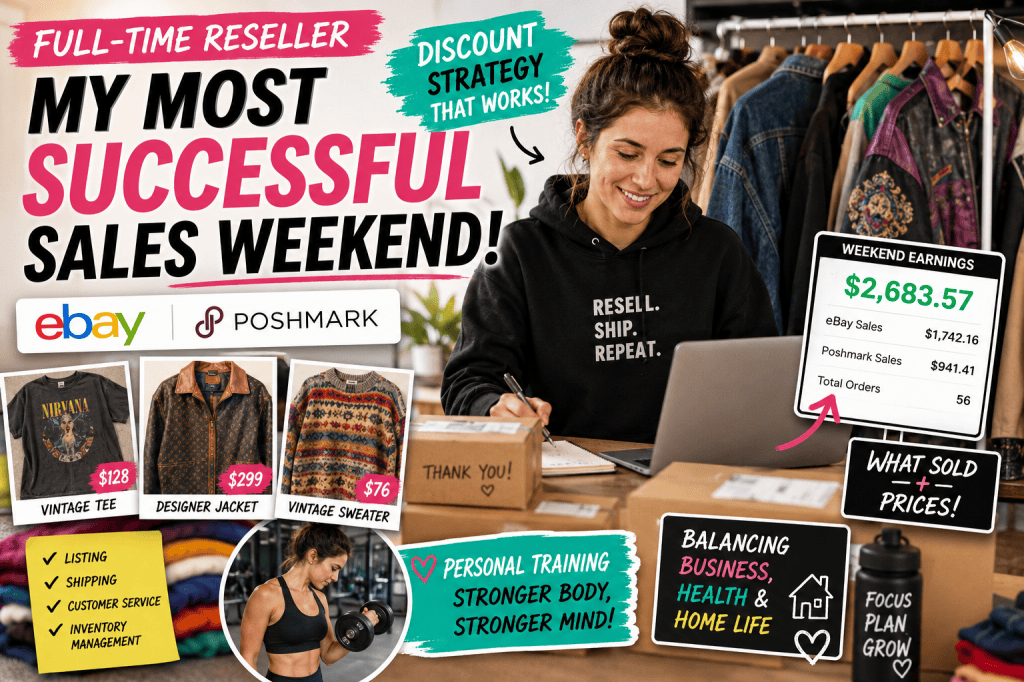
I just wrapped up one of the most intense, high-energy weekends of my reselling career! I decided to pull the trigger on a massive 40% off sale across Poshmark, eBay, and Depop, and the results were absolutely wild. In just three days, I generated $1,892 in total sales from 64 individual orders.
While the numbers look incredible on a spreadsheet, the reality of pulling that much inventory from my garage, printing labels, and hitting the gym for the first time in years taught me some hard lessons about what it actually takes to scale this business. If you’re looking to turn your side hustle into a serious operation, here are four truths you need to hear.
1. Why Lowering Your Prices Can Be Your Smartest Move
Most resellers get trapped in the “maximum price” mindset—they’d rather wait six months to get an extra $10. I’ve realized that the real secret to growth is maximum movement.
In July, my Average Sale Price (ASP) was sitting pretty at over $35. During this sale weekend, I intentionally let that drop to $29.56. Why? Because I had “stagnant” inventory that was doing nothing but taking up space. I finally moved a vintage Cache dress that had been sitting in my inventory for nearly two years. By dropping my prices, I traded a bit of margin for a massive injection of cash flow and cleared space for fresh finds.
“I am totally okay with the lower ASP because I ended up moving a ton of inventory, and a lot of it was stagnant and just sitting for a long time. Shifting the mindset from holding out for the ‘perfect’ price to prioritizing movement is what keeps a business alive.”
2. The “Gross vs. Net” Transparency Trap
When you see a “$1,800 weekend” headline, it’s easy to get stars in your eyes. But as a lifestyle entrepreneur, I have to be transparent: that $1,892 is the gross total. By spreading my sale across three platforms, I maximized the “eyes” on my items, but each platform takes its cut.
Here is how the sales broke down by platform:
- Poshmark: $1,205
- eBay: $534
- Depop: $153
Remember that $1,892 is before fees and before taxes. Between platform commissions and self-employment taxes, your “take-home” is always lower. If you aren’t accounting for those costs from day one, you don’t have a business—you have an expensive hobby.
3. The High-Margin Secret of “The Bins”
The only reason I can afford to run a 40% off sale and still be highly profitable is my sourcing strategy. About 65% of my inventory comes from the Goodwill Bins, where I pay by the pound. This “weight-based” cost of goods (COGS) is extremely low, which “subsidizes” the more expensive items I buy at regular Goodwills or Plato’s Closet.
Because my Bins COGS is so low, I can happily sell a Life is Good “crusher” tee for $13 or a Garnet Hill 100% linen shirt for $14.40. These smaller wins allow me to take bigger risks on “home run” items, like the Desigual embroidered pants I bought at Plato’s Closet for $16 and sold for $72. My inventory is a mix of high and low, including:
- Trend & Condition Finds: Soft Surroundings tunics, Dress Barn blouses with “fairy core” vibes, and Athleta trousers.
- High-End Staples: Theory men’s trousers, Lululemon jackets, and Eileen Fisher merino wool cardigans.
- Natural Fibers: 100% linen pieces from Marco Peshi and Garnet Hill.
4. The Physical Toll of the Digital Hustle
Reselling might happen on an app, but the fulfillment is manual labor. Pulling 64 orders from a garage involves constant bending, reaching, and lifting. After years of this, I realized my body was, quite literally, “creaking through life.”
I finally sucked up my anxiety and hired a personal trainer. I was so nervous about going back to a gym after years away—I was genuinely worried I might faint, vomit, or worse! But the experience was eye-opening. My trainer pointed out that because of my daily repetitive motions, I have been overusing my quads while my butt and the back of my thighs (hamstrings) have become incredibly weak.
“I am so sore… my body is just creaking right now. I’ve been feeling so weak the last few years, and I realized I don’t even know how to hold a weight or use a machine. I’ve been avoiding using the muscles I actually need for this job.”
If you want longevity in this game, you have to maintain your “human machinery” as much as your digital storefront.

The Final Thought: Success is About Movement, Not Perfection
At the end of the day, a successful reselling business isn’t built on finding one Free People quilted jacket; it’s built on the consistent flow of inventory. Whether it’s a high-end designer piece or a $13 graphic tee, the goal is to keep things moving out of the garage and into the mail.
As you look at your own life and business, I have two questions for you:
- Are you holding onto “stagnant” projects or ideas in hopes of a perfect outcome, or are you willing to lower the “price” to finally get them moving?
- Are you neglecting your physical health in the pursuit of your hustle, or are you building a body that can actually sustain your dreams?
How did the 40% discount affect sales and inventory turnover?
The 40% discount run over the three-day weekend had several notable effects on both sales performance and inventory turnover:
- Boosted Sales Volume and Revenue: The sale generated $1,892 in total sales (before taxes and fees) across three platforms: $1,205 on Poshmark, $534 on eBay, and $153 on Depop. This represented 64 items sold in just three days, which was far more orders than expected.
- Reduced Average Sales Price: Offering the discount lowered the average sales price to $29.56 per item. For comparison, the average sold price in July was just over $35 per item.
- Cleared Out Stagnant Inventory: While the discount slightly lowered her profit margins per item, it successfully accelerated inventory turnover by clearing out stagnant items that had been sitting for a long time. Examples of long-standing items that finally sold include:
- A pair of Theory trousers held for seven to eight months.
- A vintage Cache dress that had been in her inventory for a year and a half to two years.
- Supported by Low Cost of Goods: This promotional strategy was highly viable because approximately 65% of the inventory is sourced from the Goodwill bins, keeping the average cost of goods extremely low.
📈 I can create a chart showing the breakdown of sales revenue and items sold across Poshmark, eBay, and Depop so you can easily compare the performance of each platform.






Leave a comment