The U.S. food truck industry is a $2.8 billion prize, but for the unprepared, the entry fee is often total insolvency. By 2026, over 36,000 trucks will be competing for the same curbside real estate. While the “rolling billboard” aesthetic is what grabs the headlines, the reality is that 80% of new vendors fail within their first year. The divide between the winners and those who vanish lies in the invisible data and strategic math. If you are prioritizing a flashy vinyl wrap over your workflow engineering and pricing ratios, you aren’t building a business; you’re decorating a disaster.
Your Menu is the Blueprint (Not the Vehicle)
The most expensive mistake an amateur can make is purchasing a truck before the menu is finalized. In a kitchen that rarely exceeds 200 square feet, every square inch must be earned. Your menu is a strategic document that dictates your equipment footprint; failing to let it drive the design results in chaotic, cramped nightmares that require five-figure retrofits.
A “menu-first” approach ensures that your layout facilitates a seamless path from raw ingredient to service window. You must map the journey of your signature dish to identify bottlenecks before they happen.
| Food Truck Concept | Workflow Priority |
| Gourmet Tacos | Speed from grill to window |
| Wood-Fired Pizza | Efficient oven cycling |
| Coffee & Pastries | Fast drink building |
As an industry consultant, I tell every client the same thing:
“Your food truck is a kitchen first and a vehicle second. When you prioritize workflow above all else, your team can fly during the lunch rush without bumping into each other.”
The 4x Multiplier: The Secret Language of Pricing
Pricing based on “market feel” or competitor rates is not a strategy—it is financial suicide. In 2026, professional sustainability is built on the Multiplier Method and strict Cost of Goods Sold (COGS) ratios.
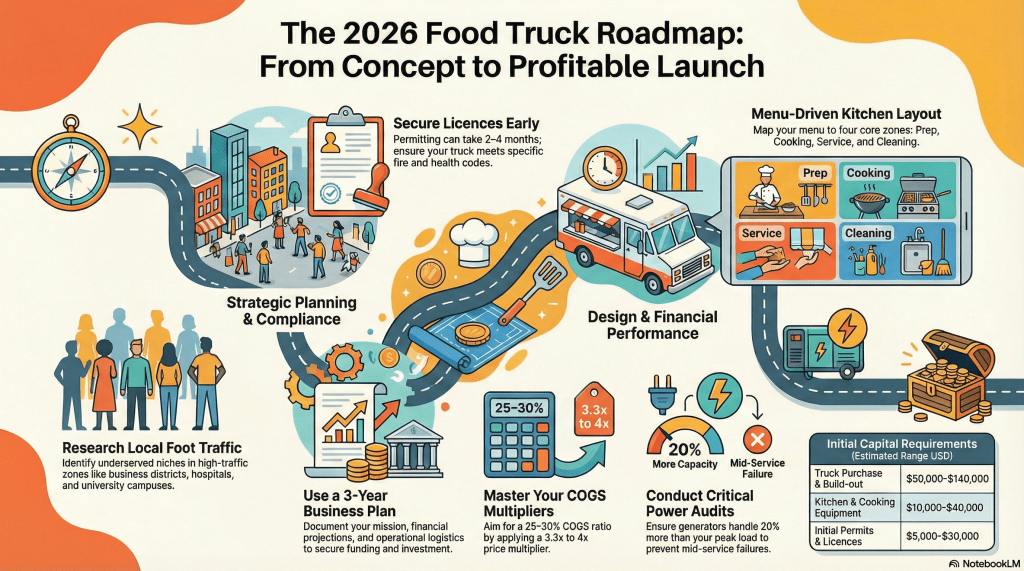
To maintain a viable operation, you must target a COGS ratio of 25–30% for food. The math is a simple flip:
- 25% COGS Ratio: Requires a 4x multiplier (1 ÷ 0.25).
- 30% COGS Ratio: Requires a 3.3x multiplier.
However, the “strategic math” deepens with your beverage program. For bars and high-end drink components, the target is even tighter, with a liquor cost of 15–20%. If your net profit margin falls below the 10–20% range after accounting for labor, fuel, and insurance, your pricing is amateur guesswork that will erode your capital.
The “Un-Glamorous” Engineering: The 15% Waste Rule
Health inspections are the “kill shots” of this industry. While most owners obsess over their grills, the inspection usually fails in the plumbing. A non-negotiable engineering requirement for 2026 is that your grey water tank must be at least 15% larger than your freshwater tank. This prevents wastewater from backing up into your fresh supply or overflowing onto the street—errors that will shut you down instantly.
To pass inspection and survive a rush, your layout must feature these four core work zones:
- Prep Zone: Counter space with access to refrigeration and a dedicated prep sink.
- Cooking Zone: The high-heat area requiring commercial-grade ventilation.
- Service Zone: The command center for your POS and plating.
- Cleaning Zone: This must include a three-compartment sink (wash, rinse, sanitize) and a mandatory, separate hand-wash sink. The hand-wash sink is a dedicated entity—do not attempt to share it with your dishwashing or prep areas.
The “Staging Car” Tactic and the Twitter Paradox
Location determines traffic, but secrecy protects it. Successful 2026 vendors utilize the “staging car” strategy: sending a standard vehicle to physically claim a prime spot hours before the truck arrives. This prevents “spot-poaching” by competitors in high-value districts.
You must also master the Twitter Paradox. While social media is a billboard for your fans, it is also a tip-off for your competitors. If you reveal a winning location too early, you invite poaching. The tactical solution is to geofence your digital reveal. Use your staging car to secure the site first, and only release the exact “where” signal once the physical territory is held.
From Lists to Narratives: The 2026 Menu Trend
For the 2026 demographic—specifically Gen Z (ages 21–34)—a menu is no longer a list of items; it is a narrative. This group is driving a massive shift toward “talk value” and “hard-to-duplicate differentiation.”
Key trends for this demographic include:
- The Umami Layer: Integrating miso, shiso, and yuzu to create complex, exotic profiles.
- The Mocktail Surge: Non-alcoholic spirits now rank as the 7th most-used ingredient type, surpassing even tequila and cognac.
- The 72% Rule: Southern Glazer’s data shows that 72% of younger consumers want half-sized drinks at half the price to maximize variety and moderation.
- Technical Authority: Use culinary techniques like rotary evaporation and house-made infusions to create custom spirits and syrups that competitors cannot replicate.
Earning the “Trust Discount” in Vendor Negotiations
Negotiation is not about hardball tactics; it is about risk reduction. In the hospitality world, professionalism earns you a “trust discount.” By paying on time and being organized, you reduce the vendor’s perceived risk, which they reward with lower pricing.
Strategic ways to slash costs include:
- Multi-Year Contracts: Lock in 2026 rates for three years to hedge against inflation.
- Off-Season Booking: Secure your sound, lighting, and equipment maintenance in the mid-winter slow period when vendors are desperate to fill their calendars.
- Relationship Equity: Vendors will often provide “trust discounts” or waive delivery fees for partners who have a proven track record of reliability.
The Precision of Foot Traffic: Why “Volume” is a Vanity Metric
In site selection, raw volume is a vanity metric. Knowing that a corner gets “1,000 visitors” is useless without visitor profiling and cross-shopping behavior data.
In 2026, you must analyze where else your customers are going. If you run a gourmet fusion truck, you need a site where the psychographic profile matches “professional management,” not just high footfall. Conversely, a late-night concept needs the 18–24 demographic found near campuses. Use data to determine if the shopping center’s visitors align with your brand’s core customer segments. Matching the visitor profile to your brand is the ultimate risk-mitigation strategy.
Conclusion: The Final Shift in Perspective
The most successful “rolling billboards” on the road today are not just trucks—they are data-driven, menu-centric kitchens engineered for high-volume output. As you navigate the 2026 landscape, remember that while your branding might bring a customer to the window, your strategic math is the only thing that keeps that window open.
In the rush to build a brand that stops traffic, have you engineered a workflow that can actually handle the crowd?
To help you confidently launch and scale your own mobile food or beverage business in 2026, I’ve put together the “Mobile Food & Beverage Business Operations Guide”—a complete step-by-step resource covering industry trends, legal compliance, strategic location planning, financial systems, and investor-ready templates. Whether you’re just starting out or looking to refine your operations for maximum profit, this guide delivers actionable insights you can implement today. Grab your copy here: https://payhip.com/b/KNup0







Leave a comment