1. Introduction: The Blank Prompt Paradox
Every creator has faced the “Blank Prompt Paradox”: you possess a vivid visual concept, yet your output remains trapped behind the limitations of a basic vocabulary. You type “cinematic lighting” and receive something aesthetically “fine,” but it lacks the visceral intentionality of a professional production. This is the inflection point where hobbyists stop and professionals begin.
To bridge this gap, you must stop viewing Large Language Models (LLMs) like ChatGPT or Claude as mere “paragraph generators.” In a professional workflow, the LLM is your architectural thought partner—a tool used to eliminate the stochastic nature of prompting and replace it with systematized control. By closing the technical loop between these two intelligences, you transform from a casual prompter into a Creative Director.
2. Building a “Knowledge Base” for Visual Vocabulary
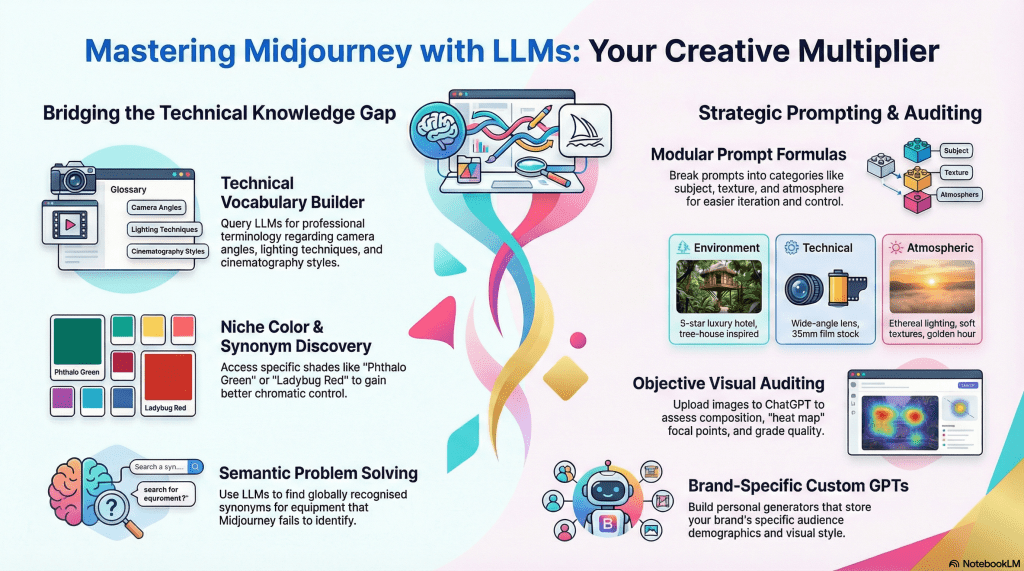
The most immediate “unlock” is using an LLM to serve as a categorical filter for your visual ideas. While Midjourney is fluent in the language of cinematography and high-end photography, most users lack the technical lexicon to speak its language.
Instead of guessing, use ChatGPT to expand your library of “Holding Categories.” Ask the LLM to suggest 25 specific lighting techniques, but go beyond the basics. A pro prompter knows that “soft lighting” is amorphous, whereas “gossamer lighting” or “ethereal lighting” paints a vastly different, more visceral picture in the latent space. By asking for the why behind a lens choice or a film stock, you aren’t just generating a prompt; you are building a mental model for how light and composition interact.
“That’s how a lot of the things I started to essentially build my… knowledge base in a sense for myself.” — Rory Flynn
3. The Synonym Hack: Navigating Token Density
Midjourney’s performance is dictated by “Token Density”—the idea that certain words trigger higher-quality clusters in its training data than others. When a prompt fails, it is often because your chosen term lacks the weight required to manifest correctly.
Take the “gas station pump” dilemma: a user prompting for a “sign” on a pump might get a billboard on top of the building. By using ChatGPT as a synonym engine, you can identify adjacent ideas like “digital display sign” to narrow the AI’s focus. This applies to color with even more precision. A generic “red” token is amorphous, but “Ladybug Red,” “Phthalo Green,” or “Canary Yellow” provide the specific visual weight needed to trigger precise, saturated results that standard color names simply cannot reach.
4. Operationalizing Consistency through Storyboarding
Consistency is the “Great Myth” of AI art. Hobbyists believe it’s luck; architects know it’s math. To maintain a consistent brand aesthetic across different subjects—such as the “Tulum Hotel” use case—you must keep the technical parameters static while swapping only the subject.
The secret sauce is a rigid Prompt Formula. When instructing your LLM to build these, you must enforce a strict rule: Use concise, visceral, powerful language. Only use keywords; do not use filler words.
The Professional Prompt Formula:
- Photo Type: (e.g., Architectural Photography)
- Subject and Action: (e.g., A welcome drink on a stone table)
- Environment: (e.g., Luxury five-star hotel in Tulum inspired by treehouses)
- Technical Parameters: (Static across all prompts: Lens, lighting, film stock)
To further flatten the learning curve for teams, you can bake this logic into a Custom GPT. By defining your brand’s age, ethnicity, and aesthetic preferences in the GPT’s instructions, you create a random prompt generator that ensures every output fits your brand’s “world,” regardless of who is typing.
5. Using the Vision API as an Objective Creative Auditor
The “Vision” capabilities of ChatGPT allow it to serve as an objective creative partner, removing the subjective bias we often have toward our own work. You can upload a Midjourney generation and ask the AI to “grade” it on a scale of 1 to 100 based on professional compositional rules.
In a marketing context, this is a game-changer for visual heat mapping. Ask the AI: “Where is the viewer’s eye going first? Does the focal point align with a Call to Action (CTA) in the bottom-left quadrant?” This objective assessment can identify if a composition naturally leads the eye or if it’s too cluttered to be effective. It transforms the AI from a tool that makes into a tool that audits.
6. The “Technical Lifesaver”: Pixel Math for Designers
Generative art often ends in the “misery” of manual formatting. For designers who need to stack images for social media or professional decks, the math involved in aspect ratios and bleeds is often a point of creative friction.
ChatGPT acts as the vital bridge between Generative Art and Graphic Design. If you need to fit three Midjourney crops into a 1080×1920 vertical square with a 50-pixel gap and a 40-pixel bleed, the LLM can perform the “pixel math” instantly. It provides the exact percentages and dimensions required to resize your assets without distortion, solving the “math problem” that typically kills creative momentum.
7. Radical Self-Analysis: The Unspoken Battle
To truly push the boundaries, you must engage in what we call the “unspoken battle” between ChatGPT and Midjourney. Instead of using ChatGPT to help the image generator, use it to challenge it.
Ask the LLM to “roast” your prompt history to find your creative blind spots. Are you defaulting to close-ups? Are your lighting choices repetitive? Instruct the LLM to find your shortcomings and suggest directions that are “5x crazier” or “unconventional.” You can even set the two AIs against each other: tell ChatGPT it is in a competition with Midjourney and ask it to write a prompt so fluid, ethereal, or complex that it forces the image generator to its absolute limit.
8. Conclusion: From Magic Buttons to Systematized Control
The evolution of AI artistry is a journey from clicking “magic buttons” to architecting “controllable systems.” Whether you are using an LLM as a technical researcher, a layout mathematician, or a strategic auditor, you are reclaiming control over the final output.
There is no “right” way to use these tools—there is only the way that gives you the most agency over the result. As these systems merge and become more “sentient” in their feedback, the role of the creator changes. The question is no longer “What can the AI do?” but “How will you use this thought partner to push the boundaries of what you can imagine?”
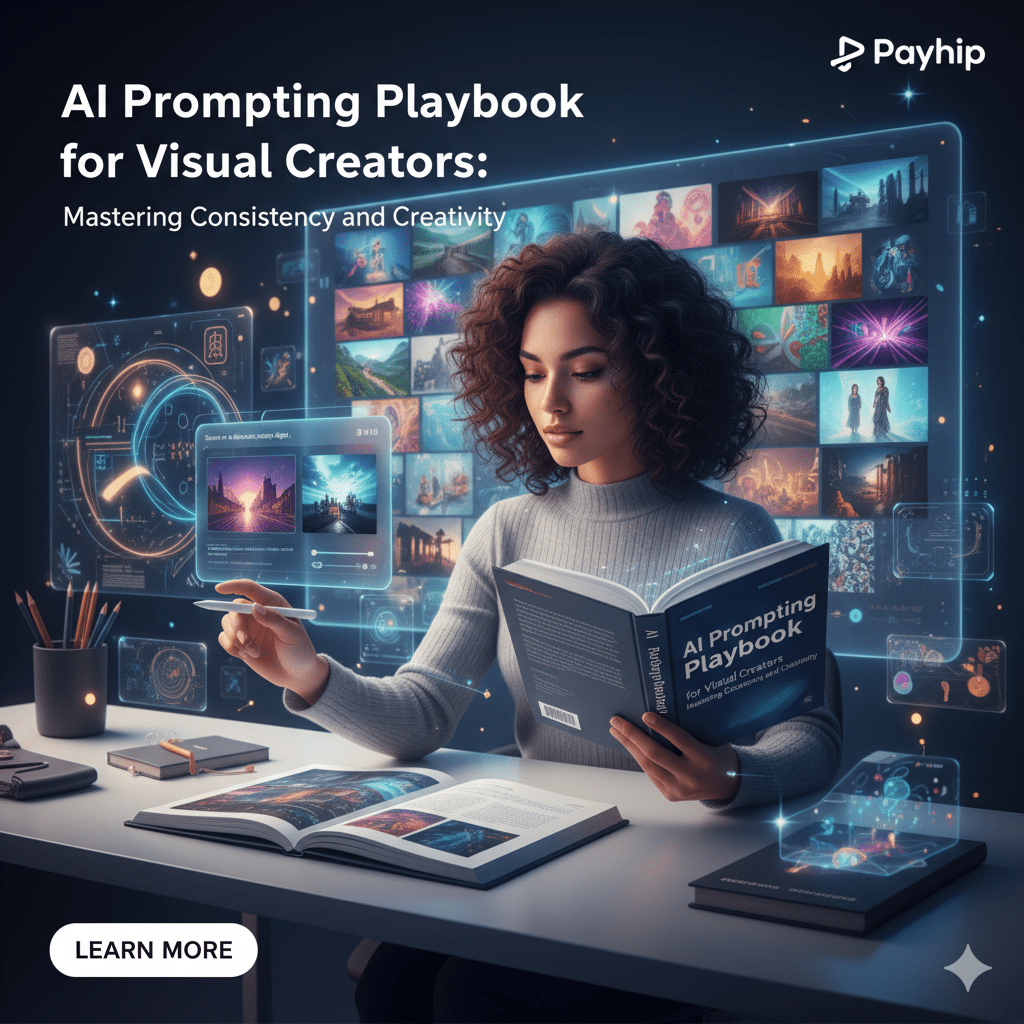
If you’re serious about moving beyond random AI outputs and want real control over your visuals, the AI Prompting Playbook for Visual Creators + ChatGPT × Midjourney Prompt Operating System (Ultimate Bundle) is built exactly for that. This system shows you how to structure prompts with intent, use ChatGPT as a creative director, and maintain consistent, brand-ready visuals using repeatable frameworks—not guesswork. It includes step-by-step workflows, prompt formulas, and fillable worksheets so you can turn ideas into predictable results. You can access the full bundle here: https://payhip.com/b/aMGxm



Leave a comment