1.0 Introduction: Beyond the Hype

The business world is saturated with advice about artificial intelligence, yet much of it is generic, unhelpful, and disconnected from reality. Many leaders feel the pressure to adopt AI, only to experiment with a few prompts and get results that are, as one sales leader described, “lifeless” and “generic.” This cycle of high expectations followed by disappointing, robotic output leads to widespread frustration and the feeling that AI is more hype than help.
This article cuts through the noise. We will reveal four impactful, non-obvious truths about leveraging AI effectively. Moving beyond simple experimentation, these insights provide a clear path to transforming AI from a disappointing magic box into a powerful tool for strategic advantage.
2.0 Takeaway 1: Your AI is a Brilliant Intern, Not a Mind Reader
The first and most critical truth is that the quality of AI output is a direct reflection of the quality of the instructions it receives. When you get a generic email or a bland analysis back from an AI tool, the problem is rarely the technology itself.
Here’s the truth from one sales leader to another: The problem isn’t the AI. It’s the prompt.
Vague instructions will always lead to vague results. To solve this, you must shift from making simple requests to giving strategic directions. The RIGS framework provides a practical structure for crafting prompts that deliver high-value, specific outputs.
- Role: Tell the AI who it is before you tell it what to do. For example, “You are a field sales expert who has handled thousands of objections in the medical device industry.” This frames the conversation and taps into the vast datasets associated with that expert persona.
- Instruction: Give a clear, direct command of what you want it to create. This is your core action, such as “Create a multi-touch cold outreach sequence.”
- Guardrails: Set the rules of the road. Define the constraints that keep the output focused and usable, such as the desired tone, word count, and exact format (e.g., “Format as: Touch 1 (LinkedIn), Touch 2 (Email), Touch 3 (Phone script)”).
- Specifics: Provide the critical context the AI needs to generate personalized output. This includes your target audience, industry pain points, key differentiators, and a competitive landscape.
This mindset shift is crucial because it places the power and responsibility for great results back in the hands of the user. AI is not an autonomous mind reader; it is a powerful, directable tool waiting for a clear set of instructions.

3.0 Takeaway 2: AI Can’t Invent Your Brand Voice—It Can Only Amplify It
Many businesses rush to use AI for content generation without first doing the foundational strategic work of defining their brand. A Large Language Model (LLM) cannot create a unique brand voice from scratch; its output is only as good as the input and instructions you provide.
Before you can ask an AI to write for you, you must have a clearly defined brand voice for it to learn from. In the age of AI, a traditional brand style guide is no longer just for human writers; it has become a critical “blueprint” for training your AI assistant to communicate consistently and authentically.
An AI-ready brand voice guide should include several essential components:
- Tone Adjectives: List the core adjectives that define your brand’s personality. Be specific. Instead of just “friendly,” you might use “approachable, thoughtful, clear, and professional.”
- Vocabulary Rules: Specify preferred phrases and, just as importantly, words to avoid. For example, you might instruct the AI to “avoid fluff like ‘paradigm shift’ or ‘game-changer’” and instead use practical language.
- On-Brand Content Examples: Provide strong “few-shot examples” of existing content—such as a blog introduction or a social media caption—that perfectly embodies your desired voice. This is one of the most effective ways to teach the model.
- Persona-Driven Prompts: Use “Act as” instructions to give the AI a specific perspective to adopt. A prompt like, “Act as our Head of Product Marketing,” gives the model clear direction on how to think and sound, aligning its tone with how your brand actually communicates.
This point is counter-intuitive but essential. The effectiveness of AI-driven content generation depends entirely on the strategic clarity you provide upfront.
4.0 Takeaway 3: Successful AI Adoption Isn’t a Sprint, It’s a Staged Marathon
A common misconception is that AI implementation is an overnight revolution—a single project that instantly transforms an organization. In reality, successful AI adoption is a phased journey of organizational maturity. A uniform, one-size-fits-all approach is ineffective because different organizations operate at different levels of AI readiness.
The most effective first step is not to buy a tool but to conduct an AI maturity assessment. This evaluation provides a clear baseline of your organization’s capabilities and identifies the most critical areas for development. According to Gartner, such an assessment should evaluate seven key areas, which can be grouped into core pillars:
- Strategy, leadership, and culture
- Data and engineering readiness
- Product and operating models
- Governance and ethics
Based on this assessment, an organization can follow a logical, phased rollout. The WMCA AI Adoption Roadmap illustrates this progression with stages that move from foundational awareness to scaled implementation, such as Phase 1: AI readiness, Phase 2: Quick wins and practical pilots, and Phase 3: Skills and governance. This staged approach allows organizations to build momentum with low-risk projects, develop internal capabilities, and align AI initiatives with strategic goals over time, ensuring adoption is both effective and sustainable.
5.0 Takeaway 4: The Real Magic Is in Strategic Workflows, Not Single Commands
While using AI for isolated tasks like writing a single email is useful, its most advanced application lies in chaining prompts to execute complex, multi-step strategic workflows. This elevates AI from a simple assistant to a genuine partner in sophisticated business processes. Instead of asking one question, you guide the AI through a logical sequence of tasks to build a comprehensive strategic asset.
Examples of these advanced multi-step scenarios include:
- Prospect Research: A five-step sequence that creates a complete, actionable prospect profile. The workflow progresses from (1) generating a company profile and (2) analyzing pain points, to (3) mapping key stakeholders and (4) developing a personalized outreach angle, before culminating in (5) preparing competitive talking points to differentiate your solution.
- Competitive Displacement Campaign: A workflow that creates a full campaign to strategically win business from a competitor. The process moves from (1) conducting territory intelligence to identify vulnerabilities, to (2) building a differentiation framework with superior talking points, (3) developing displacement scripts for specific scenarios, and (4) creating a 90-day implementation timeline to guide the campaign.
To execute these workflows correctly, there is one critical rule: all prompts in a sequence must be run in order within the same continuous chat conversation. An AI’s memory is wiped clean when a new chat is started, so maintaining a single conversation is essential for the AI to build upon the context from previous steps.
6.0 Conclusion: Your AI is a Co-Pilot, Not an Autopilot
Ultimately, AI is a strategic amplifier, not a replacement for human creativity, judgment, and strategy. Achieving real business impact requires a fundamental mindset shift. Success is not about finding the perfect tool; it’s about thoughtful preparation, clear direction, and continuous human oversight.
This means doing the upfront work of defining your brand voice, using structured frameworks like RIGS to give strategic instructions, and understanding that AI adoption is a gradual journey. Your role is to be the ultimate “brand filter”—to review, refine, and fact-check every AI output to ensure it is accurate and authentic. AI is your co-pilot, but you are, and must remain, the pilot in command.
Now that you know AI is a partner that needs clear direction, what’s the first strategic conversation you’ll have with it?
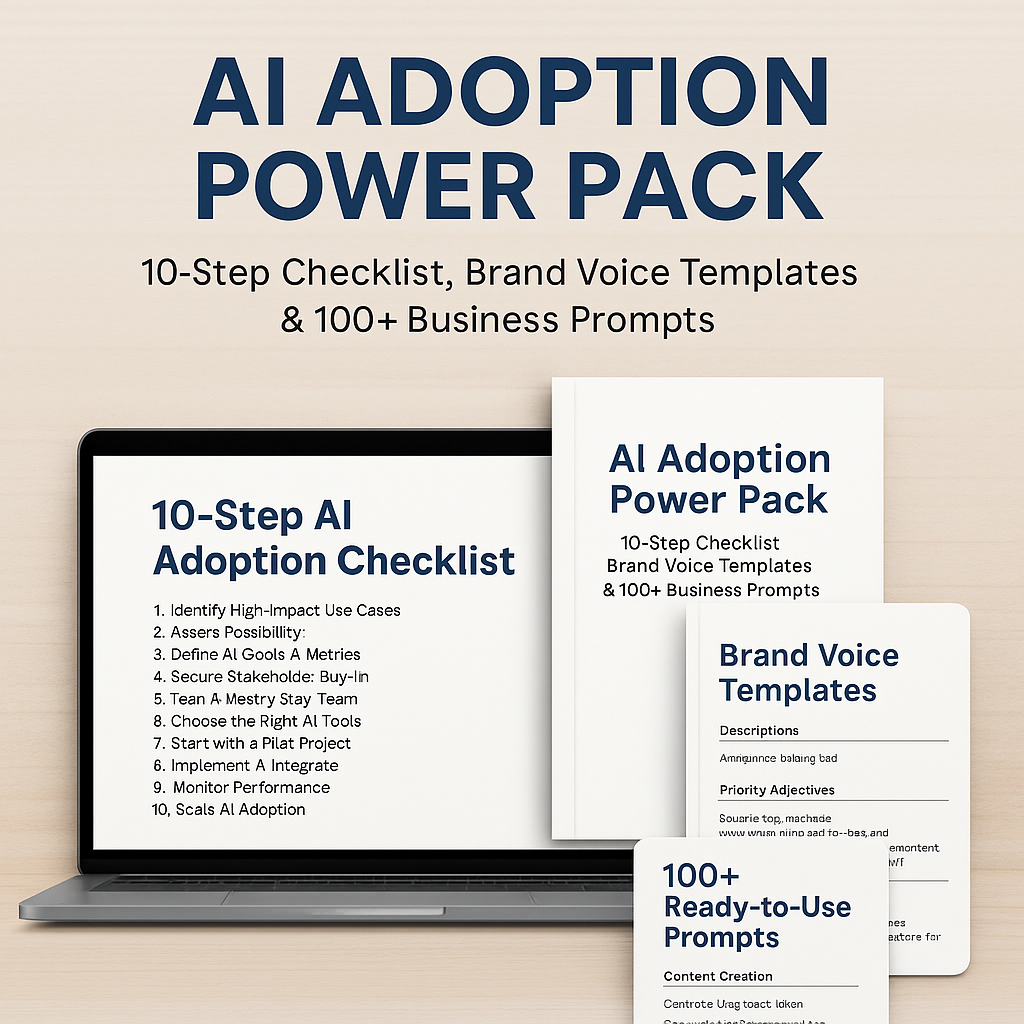
🚀 Everyone’s talking about AI, but few are actually using it right. The truth? Businesses that master AI workflows today will outpace competitors tomorrow. That’s why I’ve been using the AI Adoption Power Pack — a complete system with a 10-step checklist, brand voice templates, and 100+ ready-to-use prompts that turn confusion into clarity. If you’re serious about scaling smarter and saving time, grab your copy here 👉 https://payhip.com/b/vFAlx and start using AI like a pro — not a beginner.











Leave a comment