
For many aspiring entrepreneurs, the food truck represents the ultimate romanticized path to freedom. But behind the vibrant wraps and Instagrammable locations lies a grueling reality: hours of pre-dawn prep followed by a “park and pray” strategy, waiting in stagnant parking lots for foot traffic that may never arrive. It is a high-risk, labor-intensive model characterized by razor-thin margins and constant exhaustion.
After 23 years in the trenches, the founders of Smart Drinks have proven that the traditional food truck dream is fundamentally flawed. Their counterintuitive solution? Success doesn’t come from selling food; it comes from engineered convenience. By stripping away the “grease” and focusing on a high-speed beverage model, they have turned a Mercedes van into a powerhouse of efficiency that represents a total inversion of the traditional food truck’s pained P&L.
Stop Waiting, Start Hunting: The Logic of Logistical Density
The most significant strategic pivot in the Smart Drinks model is the shift from stationary parking to scheduled, high-density routes. While traditional trucks are at the mercy of the crowd, these mobile units “hunt” their revenue. This philosophy is rooted in being a “convenience business” rather than just a smoothie shop.
By targeting locations with a captive audience of at least 30 employees—car auctions, warehouses, and dealerships—the vans become an essential, scheduled part of the workday. The strategy relies on logistical density: minimizing “windshield time” by clustering stops. For instance, car auctions serve as the primary revenue anchors from 9:00 AM to 12:00 PM, where a line of 1,500 people can generate $500 to $1,000 in a single window. To maximize the day, operators “fill in” gaps with neighboring car dealerships, ensuring the van is always selling rather than driving. By the time most food truck owners are just opening their windows for lunch, a Smart Drinks unit has already secured its daily baseline.
“You know, we’re in the convenience business because we come to our customers, and as soon as we finish selling, we start up the vehicle, and we go to our next stop.” — Charles, Founder of Smart Drinks
The 80% Margin: Why Drinks Trump Food
The unit economics of the mobile drink model are staggering compared to the broader culinary industry. While the average food truck operates on a thin net profit margin of approximately 6.2%, Smart Drinks achieves a gross profit margin of roughly 80%.
This financial advantage is driven by high-ticket items—such as $9.50 protein smoothies—paired with a radical reduction in waste. Unlike food, which requires complex prep and spoils rapidly, beverage ingredients are far more stable. Furthermore, by removing “grease” from the equation, the business slashes overhead and labor. These units are designed for peak efficiency as owner-operated modules, eliminating the bloated payroll that often consumes food truck profits. Without the deep-cleaning requirements inherent in heavy cooking, cleaning time is reduced from hours to mere minutes, allowing the operator to focus entirely on the next revenue-generating stop.
Engineering for Speed: The “Bible” of Operations
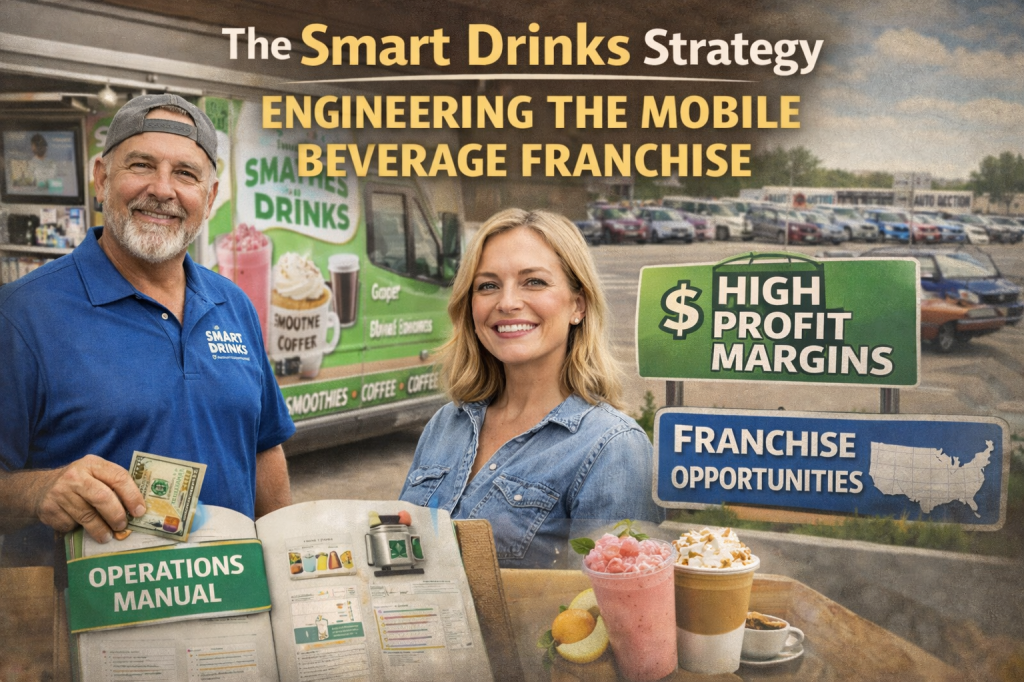
To handle the sheer volume of a 1,500-person auction line, Smart Drinks has spent two decades refining its “Operations Manual,” a document the founders treat as a literal Bible of efficiency. This level of systematization allows for a staggering output capability of 175 to 200 drinks per hour.
The manual focuses on granular time savings that scale. One prominent “hack” is the specialized four-banana peeling technique, which transforms a 20-minute task into a five-minute sprint. To maintain quality without the labor of prep, they utilize a network of 30 specialized vendors providing pre-packaged, name-brand fruit like Dole pineapple and Del Monte peaches. This eliminates 2–3 hours of cleaning and cutting strawberries or pineapples daily.
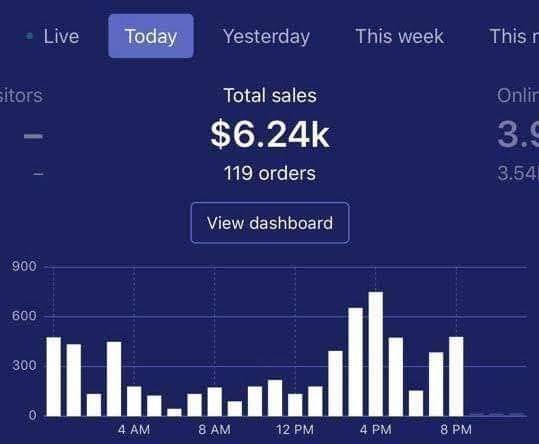
Speed is the ultimate driver of revenue. This “expediting” system was recently validated at a hospital event where a single van, utilizing a condensed event menu, generated $4,500 in sales plus a $600 tip—totaling $5,100 in just four hours. When operations are this refined, the unit isn’t just a van; it’s a high-speed assembly line.
High-End Hardware and the Financing of a “Mobile Office”
The Smart Drinks model utilizes a high barrier to entry to ensure operational reliability. Each unit is built on a Mercedes 3500 Sprinter, a heavy-duty series specifically chosen to handle the 4,000 lbs of equipment required for high-volume service. The $86,900 build-out includes a $20,000 professional espresso machine, a $15,000 Onan generator, and a $3,000 drive-through window.
While the total investment of $150,000 may seem daunting, the founders have engineered the financial barrier to be surprisingly accessible. Smart Drinks is an SBA-registered lender, meaning banks can immediately verify the franchise’s viability. Furthermore, Mercedes Finance frequently offers 100% financing on the vehicle, plus tax and license, while often covering 50% of the build-out costs. This specialized financing allows entrepreneurs to enter the market with as little as $20,000 in liquidity.
Investing in “first-class” hardware is a strategic choice to avoid the mechanical failures that plague cheaper, DIY trucks. For the founders, this is the ultimate alternative to the traditional retail model.
“I’m not going to do a brick-and-mortar store because you have employees, you have headaches—I don’t want to go through all that. [With the mobile unit], I call the shots. I don’t have to ask for permission or forgiveness.” — Charles
The “Shore Power” Secret to Lifestyle Freedom
One of the most grueling aspects of food service is the daily “load-in/load-out” process to prevent spoilage. Smart Drinks eliminates this through a “Shore Power” system. At the end of the shift, the operator simply plugs the van into a standard power outlet. This keeps the onboard refrigeration running overnight, ensuring that the fruit, milk, and inventory stay perfectly chilled without being moved.
This system, combined with the “no grease” nature of the business, offers a level of lifestyle freedom rarely seen in entrepreneurship. It allows for a “park and go” routine. The founders even noted that they can go on vacation and simply park the van for weeks; because they provide a scheduled convenience rather than just a meal, customers are waiting and ready the moment they return.
Conclusion: Your Dream or Theirs?
The success of the Smart Drinks model is a testament to the power of combining consistency with a visionary mindset. After 23 years, the primary takeaway is that true mobile success requires the discipline to follow a proven, high-margin system rather than chasing the “broken dream” of the traditional food truck.
In the end, entrepreneurship is about building a safety net. As the founders suggest, the biggest risk isn’t the $150,000 investment; it’s the opportunity cost of spending your life fulfilling someone else’s dream while leaving your own family with no equity.
If you could eliminate the “grease” and the “waiting” from your business idea, what would be left—and how fast could you start?





Leave a comment