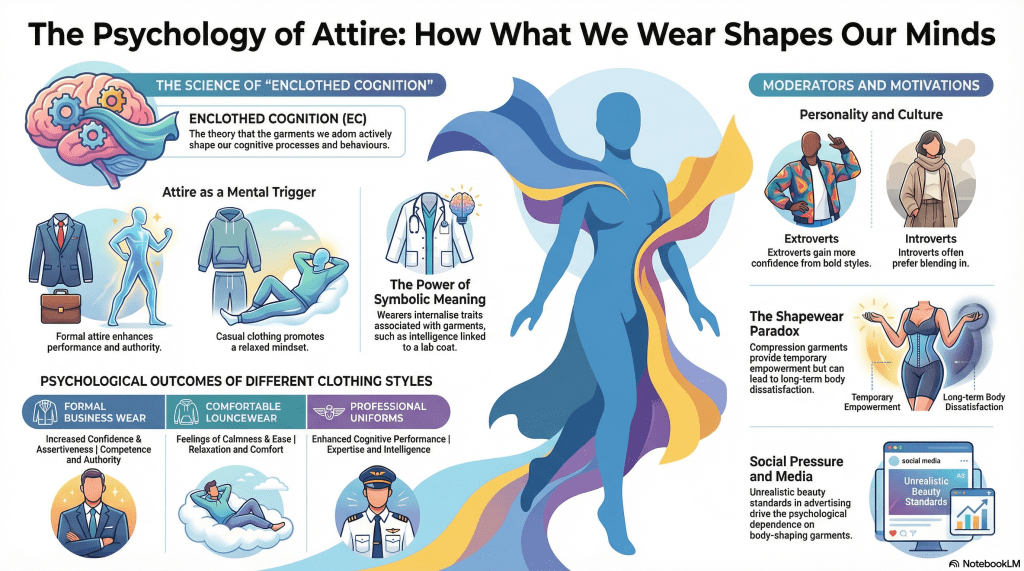
Every morning, we perform a silent ritual that feels purely aesthetic, standing before our wardrobes to curate the day’s image. We might reach for a structured blazer to command a boardroom or a soft cashmere knit to soften a difficult afternoon. While we believe we are simply dressing for the weather or a social code, we are actually engaging in a sophisticated form of cognitive priming.
There is a silent dialogue between our skin and our psyche, a phenomenon researchers call Enclothed Cognition (EC). This concept suggests that our garments do not merely shield us from the elements; they actively negotiate with our brain’s architecture. The choices we make at the mirror dictate the “vibe” of our day by fundamentally altering our cognitive processes and self-perception.
You “Think” Your Clothes: The Lab Coat Effect
The research of Adam and Galinsky (2012) suggests that garments act as psychological triggers, but with a fascinating catch: the effect depends entirely on symbolic association. In their landmark study, participants wearing a white lab coat showed significantly higher focus, but only when they believed it was a doctor’s coat. When the same garment was identified as a “painter’s smock,” the cognitive benefits vanished, proving that our brains respond to the meaning we assign to the fabric.
This mental alchemy is so potent that we don’t even need to physically don the attire to feel its weight. Studies by Chen et al. (2015) reveal an “imagination factor,” where simply visualizing ourselves in a specific outfit can activate the associated psychological states. Our mental imagery is powerful enough to bridge the gap between the closet hanger and our internal state of mind.
“The clothes we wear are not merely passive coverings but active influences on our thoughts, feelings, and behaviors.”
The “Power Suit” is More Than a Cliche
The “power suit” is not just a relic of 1980s corporate culture; it is a scientifically backed tool for cognitive enhancement. Wearing formal attire has been shown to evoke internal feelings of status and authority, which in turn facilitates abstract thinking and broader perspective-taking. When we dress with structure, our minds often follow suit, shifting into a more assertive and high-functioning gear.
Conversely, the rise of “athleisure” and casual wear invites a different psychological landscape characterized by calmness and ease. These comfort-based choices promote a laid-back mindset, which is ideal for recuperation but potentially counterproductive in high-stakes environments. Strategically leveraging this contrast—choosing tailored pieces for a negotiation and fluid fabrics for creative brainstorming—allows us to hack our own productivity.
Shapewear and the Confidence Paradox
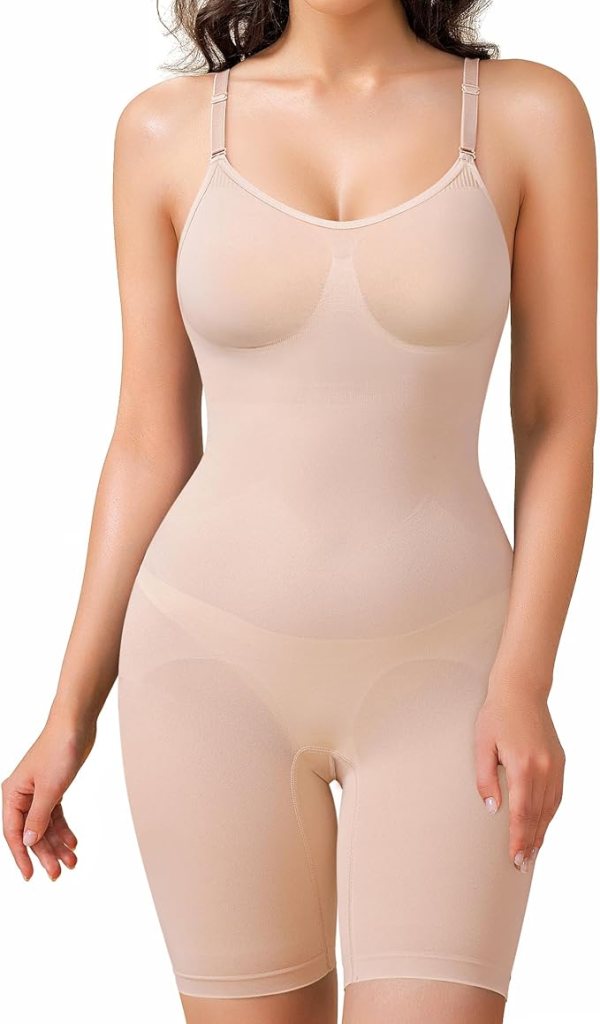
The psychological impact of fashion delves even deeper than our top layers, extending to the compression garments we wear beneath. According to research from Robert Matthew, shapewear offers an immediate sense of “empowerment” and “control” by cinching the body toward a perceived aesthetic ideal. This temporary physical transformation can provide a vital surge of confidence in social settings where one might otherwise feel vulnerable.
However, this creates a “confidence paradox” that requires careful navigation. While the garment provides an instant boost, the reliance on an external aid can foster unrealistic expectations of one’s natural form. This often leads to a cycle of dissatisfaction or a “negative self-image” once the garment is removed, highlighting the delicate tension between temporary empowerment and long-term self-acceptance.
Your Personality is the Volume Knob
Individual differences act as the volume knob for these psychological effects, determining how loudly a garment “speaks” to the wearer. Extroverts, who naturally crave social stimulation, often find that bold, attention-grabbing styles act as a catalyst for their innate assertiveness. For these individuals, a vibrant palette or an avant-garde cut isn’t just a choice; it’s fuel for their sociability.
Introverts, by contrast, may find such “loud” clothing overstimulating or draining, preferring reserved styles that allow them to observe without being observed. This interplay is further moderated by cultural backgrounds, specifically the tension between collectivist and individualist values. As Smith and Bond (1998) observed, those from collectivist cultures may derive security from “conformity” and blending in, whereas individualistic cultures equate confidence with unique self-expression.
The “Feel” of the Fabric Shapes Your Demeanor
While symbolism addresses what our clothes represent, the physical architecture of the garment introduces a more visceral layer of embodied influence. There is a profound distinction between the symbolic meaning of a “professional” shirt and the actual sensory experience of its restrictive collar. This physical feedback loop directly informs our behavior; for instance, tailored fits often promote a serious, focused demeanor.
Texture also serves as a subtle emotional thermostat for our internal landscape. The fluid elegance of silk can evoke a sense of sophisticated grace, while the heavy, tactile weight of wool often provides a psychological sanctuary of security and warmth. Even the “looseness” of a fit can be transformative, as unrestrictive clothing is frequently linked to a more creative and expansive cognitive style.
“The phenomenon of enclothed cognition underscores the profound impact of clothing on our psychology… recognizing the potency of clothing in influencing psychological states offers avenues for personal empowerment.”
Conclusion: Dressing with Intention
We are finally beginning to understand that our wardrobes are not just storage for fabric but toolkits for mental well-being. By practicing mindful clothing selection, we can move beyond mere vanity and toward a strategic alignment of our inner goals and our outward appearance. Clothing should be a vehicle for authentic self-expression, a way to signal to ourselves—and the world—exactly who we intend to be.
When we dress with intention, we are no longer just conforming to societal pressure; we are curating our own psychological reality. We must learn to view fashion as a form of self-care that begins the moment we open our closet doors. The next time you reach for an outfit, pause and ask yourself, “Is this garment merely covering my skin, or is it the mindset I want to inhabit today?”





Leave a comment