For a decade, Augmented Reality (AR) was the technology of “someday”—a futuristic novelty relegated to gaming or awkward marketing stunts. By 2025, that narrative will have been buried. We have officially moved past the sci-fi hype and into a high-ROI reality where spatial computing is no longer a gimmick but a fundamental pillar of global commerce.
The market has shifted because businesses finally addressed the “imagination gap.” In traditional digital commerce, consumers struggle to bridge the distance between a flat 2D image and the reality of how a product fits into their lives. In 2026, the data proves that AR has closed this gap, transitioning from an “optional extra” to a strategic necessity for any business navigating a landscape where the interface is disappearing.
1. The End of “Return Culture” and the 94% Conversion Leap
The most compelling argument for AR in 2026 is the bottom line. This is the transition from visual marketing to visual certainty. It is no longer about seeing a product; it is about “living with it” before the purchase. Data from Shopify reveals that products featuring 3D/AR content see an average of 94% higher conversion rates. This is not a marginal gain—it is a near-doubling of sales efficacy.
By providing visual certainty, AR has become the primary weapon against the high costs of reverse logistics. Retail studies indicate that brands employing AR visualization have reduced product return rates by up to 40%. When a customer can confirm the scale of a sectional in their living room or the exact shade of a cosmetic on their skin, the uncertainty that drives returns evaporates.
“AR assists retailers in reducing the cost of consumer attention, personalizing marketing at scale, and blurring the line between digital and physical shopping… effectively humanizing digital commerce.”
2. The Hardware Reality Check: Why the Vision Pro Paused While Glasses Ran
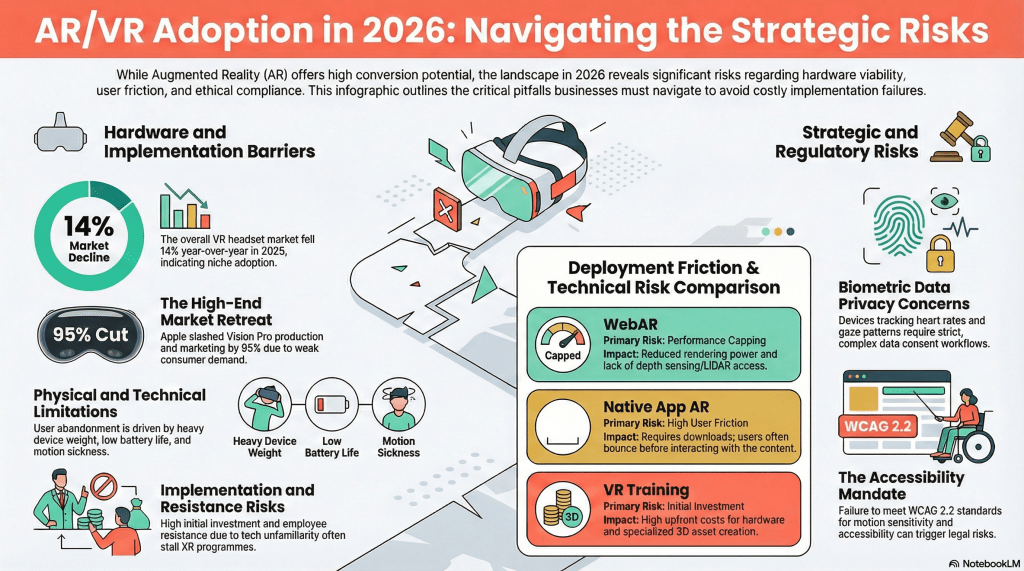
The hardware landscape of 2026 offers a sobering lesson: isolation is a hard sell. While the Apple Vision Pro entered the market with immense fanfare, its $3,499 price point and “headset-as-a-helmet” form factor led to a strategic retreat. Production was halted after shipping only 390,000 units, and digital ad spend for the device was slashed by over 95%.
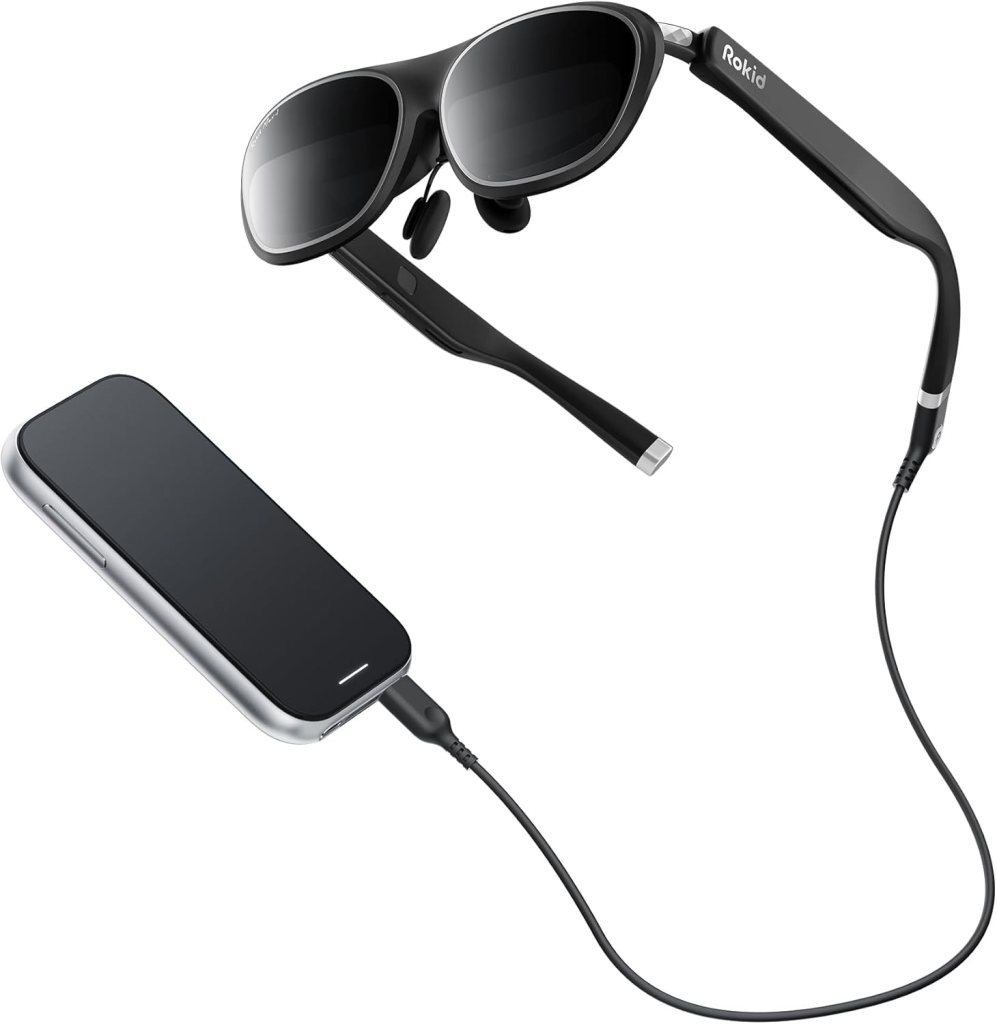
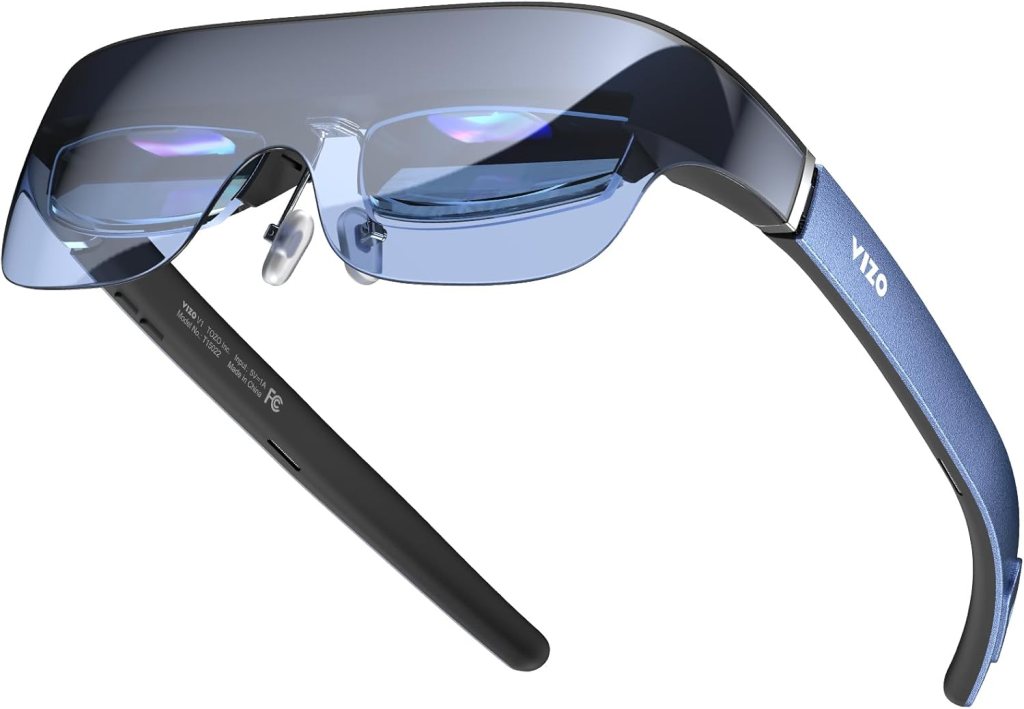
The market has signaled a clear preference for context over immersion. This is why lightweight, AI-powered smart glasses—like the Meta/Ray-Ban collaborations—have seen mainstream adoption. Consumers want “smart eyewear” that enhances their existing environment rather than replacing it. This shift toward “Vision “Air”-style wearables proves that the future of AR is wearable, social, and unobtrusive, rather than a bulky destination device.
3. The “App-Less” Revolution: WebAR as the Frictionless Future
Friction is the killer of ROI. One of the most significant strategic shifts in 2026 is the migration away from dedicated AR apps toward WebAR. Historically, requiring a user to download a specific app was a massive barrier to entry. Today, the browser is the operating system for the physical world, allowing users to launch experiences via a simple QR code or link.
WebAR experiences reach 2–3x more users than their app-based counterparts. Tools like Kivicube and the 8th Wall platform have democratized access, allowing small businesses to deploy sophisticated 3D models directly into standard mobile browsers.
Why it’s counter-intuitive: The best AR isn’t an app; it’s a link. By eliminating the download barrier, businesses integrate spatial experiences into the natural flow of web browsing. In 2026, the most successful spatial strategies are the ones the customer doesn’t have to work to find.
4. The 15-Minute Expert: How VR Slashed Training Times by 96%
Inside the organization, the market has moved beyond training to digital muscle memory. The landmark Walmart case study—reducing eight hours of training to just 15 minutes via VR—remains the gold standard. This 96% reduction in labor hours proves that immersive environments can accelerate the onboarding of complex tasks at a scale traditional methods cannot match.
The advantage is rooted in kinesthetic learning. While traditional lectures result in a measly 5–10% retention rate, VR training achieves a 75% retention rate. Employees are not just observing; they are performing tasks in a space where the cost of a mistake is zero.
“Employees can practice high-risk procedures and scenarios in a virtual environment without the fear of causing harm to themselves or others… in the safety of a controlled setting.”
5. Interactive Storytelling: The Rise of the “Talking” Product
In 2026, every SKU is a media channel. The trend popularized by “19 Crimes” wine—where AR labels tell the brand’s story—led to a 40% increase in sales volume. This transition of products from static goods to engagement platforms is now the industry standard for consumer packaged goods.
This “spatial storytelling” has also revitalized the physical storefront. Retailers utilizing AR storefront activations and murals have reported 11x higher engagement than static 2D displays. These interactive storefronts turn passive passersby into active participants, with nearly 70% of consumers taking action after engaging with a digital out-of-home AR ad. Products without an AR layer are increasingly viewed as “dead” inventory.
6. The AI-Powered “Android Moment” for Small Businesses
The barrier to entry for spatial commerce has collapsed, resulting in the “Android moment” for AR—a shift from custom-coded luxury to standardized necessity. AI tools like Polycam and Kaedim have democratized the digital twin, allowing even local entrepreneurs to convert 2D photos into high-quality 3D assets in minutes.
With nearly 60% of the U.S. population now using AR regularly, the technology has moved from a Fortune 500 luxury to a baseline requirement for consumer trust. Whether it is a local contractor providing a virtual walkthrough of a remodel or a restaurant offering a 3D menu, the ability to provide “spatial intelligence” is now the minimum viable standard for transparency.
Conclusion: Beyond the Screen
As we navigate 2026, the line between digital and physical is no longer blurred—it is being erased. We have entered the era of spatial intelligence, where the value of a business is tied directly to its digital twin and its ability to interact with the physical world in real time.
The question for leadership is no longer whether to adopt these tools, but how to master them. In a world where the spatial version of your brand is the only one your customers trust, are you building a product—or are you building an experience?
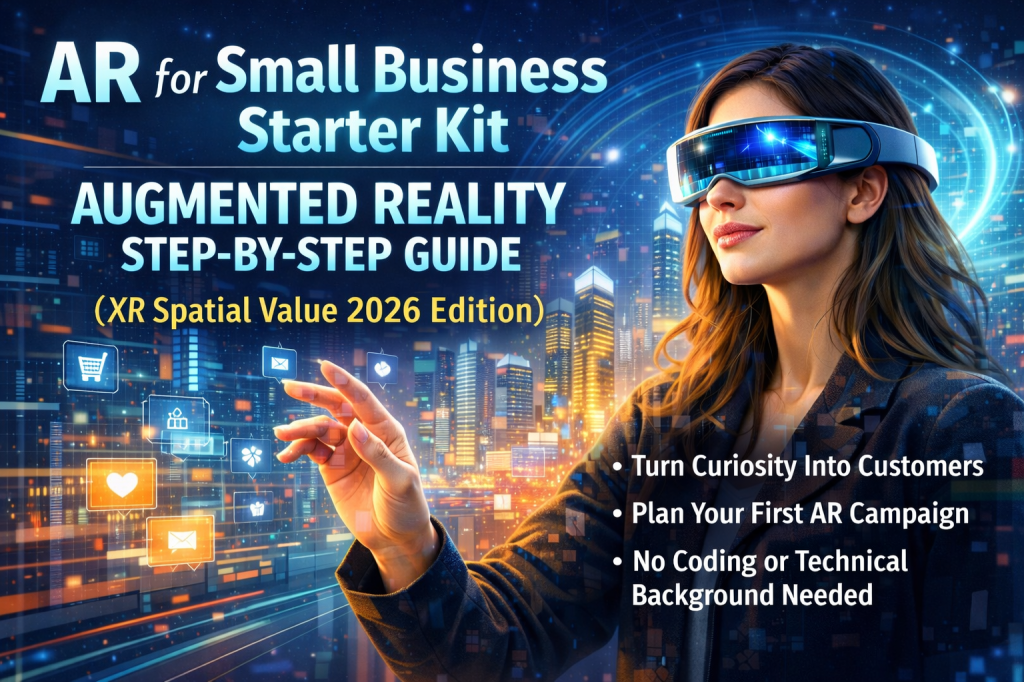
If you’re a small business owner, marketer, or startup founder looking to turn emerging technology into real customer engagement, the AR for Small Business Starter Kit – Augmented Reality Step-by-Step Guide (XR Spatial Value 2026 Edition) is a practical place to begin. This downloadable guide breaks down augmented reality into clear, actionable steps—covering no-code tools, campaign planning, budget strategies, and real-world use cases so you can start experimenting without technical overwhelm. Whether you run a retail shop, service brand, or digital agency, this resource helps you move from curiosity to implementation. You can access the full digital download here: https://payhip.com/b/j60tv








Leave a comment