1. The Modern Uncertainty Trap
In the structural design of the modern home, there is a persistent, low-frequency vibration of instability. We feel it in the background noise of global shifts, economic volatility, and cultural fragmentation. For many parents, the response is a defensive posture—a desire to insulate and isolate. However, a strategist understands that true resilience is not the absence of stress but the presence of a robust internal architecture.
As we navigate what the source context defines as “uncertain times,” we must distinguish between “end times” and “life times.” While we prepare for global events, the most immediate threats are often personal: the sudden loss of a job, a medical crisis, or a domestic accident. These are the “lifetimes” that test the integrity of our family structure. Our thesis is simple: true resilience is not merely about a basement full of grain; it is about the “blueprint” of the mind and spirit. To raise a family that stands firm, we must focus on the intentional leadership of the home and the visionary engineering of our children’s character.
2. Bravery is a Muscle, Not a Trait
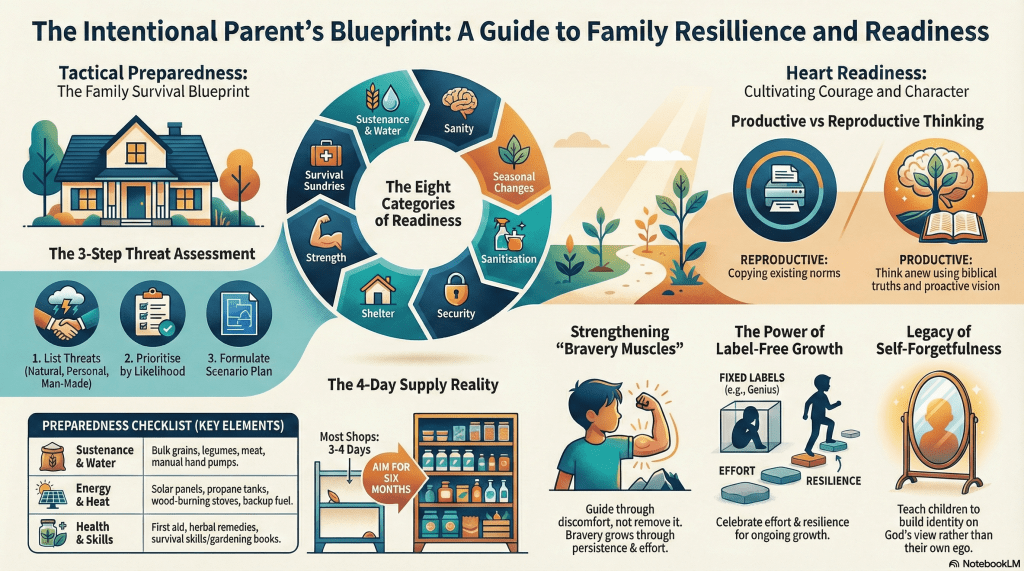
Tactical bravery requires a fundamental recalibration of the parent’s defensive instinct. A common architectural flaw in modern parenting is the belief that bravery is an innate trait. Clinical evidence suggests otherwise: bravery is a “mental muscle” grown through persistence and the specific effort of attempting new things.
The guiding mantra for this development is “uncomfortable being uncomfortable.” When a child is in distress, the primal parenting instinct is to “scoop up” the child to remove the discomfort. Strategically, this is a failure; it reinforces anxiety by signaling to the child’s nervous system that they are incapable of handling the stressor and that the world is inherently unsafe.
Instead, we employ “validated exposure.” We acknowledge the distress—validating the feeling—but we remain as a guide, staying with them in the situation rather than removing it. This creates new neural pathways that signal, “I can adapt to this.”
“As caregivers, our instinct is to run in and protect and maybe scoop up… it sends a message even to your body, like, ‘We just have to protect you right now’ as opposed to your guide.” — Dr. Melissa Giglio
3. The 5-Step Assessment and the 8 Pillars of Preparedness
Resilience is built when a family moves from reactive “freaking out” to a proactive “provisions” mindset. This begins with a technical 5-step threat assessment to identify the specific challenges your local environment may face:
- Step 1: List the threats most likely to affect your location across four categories: Natural Disaster, Extreme Weather, Personal Disaster, and Man-Made Disaster.
- Step 2: Circle the one threat in each category that is most likely to occur.
- Step 3: Prioritize those four threats from 1 to 4, with 1 being the most probable.
- Step 4: Choose the one threat that currently causes the most concern.
- Step 5: Formulate a primary plan for that scenario using the categories of preparation.
A comprehensive family blueprint should be organized around these essential pillars:
- Sanitation: Hygiene, waste management, and the prevention of disease.
- Sustenance: Bulk food storage (grains, legumes, meat) and production (gardens, livestock).
- Survival Gear: Essential tools for repair, navigation, and lighting.
- Shelter: Home maintenance and mobile “getaway” options like an RV or trailer.
- Sanity: Mental endurance, morale-boosting activities, and books that preserve a biblical worldview.
- Security: Home protection, including tools and self-defense training (e.g., guns and ammo).
- Strength & Health: Vitamins, first aid, homeopathy, and managing the “total load” of the body’s health.
- Seasonal: Gear specifically tailored for extreme heat or cold.
- Survival Sundries: Small comforts and essential items that maintain a sense of normalcy.
We must also recognize that we do not prepare for our own household alone. A resilient family is equipped to “carry the burdens of fellow believers,” serving as a light to the neighborhood and meeting the physical needs of a community in crisis.
4. Ditch “Reproductive Thinking” for “Productive Thinking”
To lead a family through volatility, parents must reject “reproductive thinking”—the act of taking existing, often flawed systems and trying to improve them incrementally. This mentality produces “normal” results that are insufficient for today’s challenges.
Instead, we must adopt “Productive Thinking.” This is the act of “thinking anew” by suppressing past experiences and cultural expectations to evaluate what is truly best for the current environment. This often means moving “against the grain.” While running your hand with the grain of wood is safe and smooth, it rarely leads to growth. Moving against the grain may cause splinters and friction, but in parenting, this friction is the only path to long-term fruitfulness. It is the act of rejecting “how everyone else is doing it” to ensure your children are equipped for reality.
“Truly, truly, I say to you, unless a grain of wheat falls into the earth and dies, it remains alone; but if it dies, it bears much fruit.” — John 12:24

5. Diagnoses Are Not “Hardwired” Destinies
Resilience applies to the medical and developmental frontlines as well. A diagnosis, such as autism, is frequently presented as a fixed genetic impairment. However, case studies like that of Ryan Hinds—who went from a predicted life in an institution to a happy, typical life as an aerospace engineer—challenge this paradigm.
The strategy is to view such challenges as a “total load” on the child’s system. This includes biochemical, nutritional, and behavioral factors, specifically identifying triggers like heavy metal toxicity or yeast overgrowths in the gut. By treating the condition as a medical illness rather than a hardwired destiny, families can find a pathway off “Autism Island.” Through a multi-faceted approach involving diet, Applied Behavior Analysis (ABA), and consistent medical treatment, children can experience dramatic improvements and achieve “normalcy.”
6. The Legacy of “Self-Forgetfulness”
In an era of relentless self-promotion, the most counterintuitive survival skill is “self-forgetfulness.” We must teach children that most “hurt feelings” are actually “hurt egos.” Self-forgetfulness isn’t thinking less of oneself; it is thinking of oneself less. When a child’s identity is built on unconditional love rather than performance or ego-preservation, they become functionally unbreakable.
A self-forgetful person is not devastated by criticism because their identity is not tied to the opinions of others. They see correction as an opportunity to change and grow.
The Ego Exercise: To model this, parents must lead by example. Ask yourself these questions from the family blueprint:
- “Am I aware of my self-preserving attempts to build up my own ego?”
- “Have I modeled for my children being able to take criticism well and thoughtfully?”
- “Am I a ‘regular repenter’ who seeks reconciliation when I have failed?”
7. Conclusion: The Forward-Looking Summary
A “Family Survival Blueprint” is not a static document hidden in a drawer; it is a living commitment to “visioneering” as a marriage team. We must constantly dream, evaluate, and plan our mission together. Preparation is the ultimate act of love—not because we are driven by the fear of what is coming, but because we are responsible for the light we raise to face it.
True resilience is the byproduct of a home where leadership is intentional, the ego is secondary, and we are more concerned with our contribution to the world than our safety within it.
Are you currently raising your children to be safe in the world, or are you equipping them to be the ones who strengthen it?








Leave a comment