1. Introduction: The End of the “Set and Forget” Era
The days of launching a generic storefront and letting static ads drive passive revenue are officially dead. As we navigate the complex, AI-integrated landscape of 2026, store management has transitioned from a manual checklist to a high-speed technical chess match. The competition is no longer local; you are now vying for attention against a global base of over 875 million Shopify users.
In this environment, merchants must proactively navigate shifting international regulations and evolving privacy laws. Survival in 2026 requires more than just “optimizing”—it requires a fundamental pivot toward technical agility and brand humanization. This article distills five essential strategic shifts, backed by the latest industry data, to ensure your business remains a leader rather than a casualty of technological friction.
2. The EU “Micro-Customs” Duty: A Per-Item Game Changer
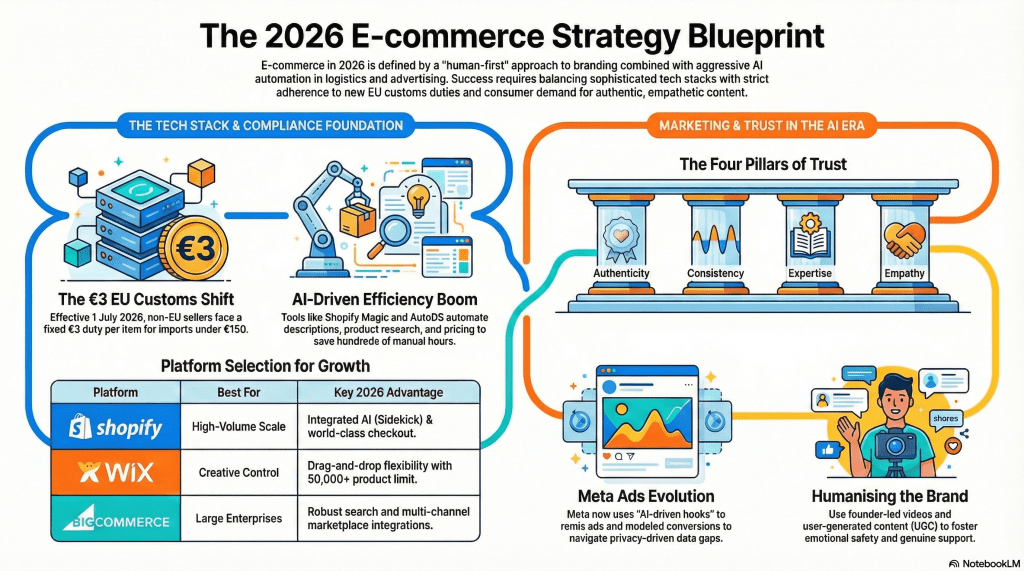
A seismic regulatory shift is set to take effect on July 1, 2026. The EU Council has ratified a temporary customs duty of €3 targeting low-value goods (under €150) entering the Union. While this aims to address systemic distortions, the technical implementation is what will break unprepared brands.
This duty applies specifically to non-EU sellers registered under the Import One-Stop Shop (IOSS)—a group that currently accounts for 93% of all cross-border e-commerce imports into the EU. Crucially, the duty is calculated per item based on tariff classification, not per parcel. For example, a single parcel containing a smartphone, a charger, and earphones will be hit with a €9 duty because they fall under distinct tariff headings. Compounding this, a proposed €2 handling fee per parcel is currently under negotiation, meaning a single multi-item shipment could face upwards of €11 in additional logistical friction.
To protect your unit economics, I recommend a pivot toward multi-item SKU consolidation or utilizing IOSS-optimized shipping lanes. Sellers must either move inventory to EU-based warehouses or rethink bundling strategies to minimize the number of tariff headings per shipment.
“The measure is a transitional response to years of concerns about unfair competition, valuation fraud, and environmental impacts from parcel splitting associated with e-commerce imports.” — Council of the European Union
3. The Rise of the AI “On-Call Co-Founder”
AI has evolved beyond the “chatbot” phase, becoming an integrated business partner capable of high-level strategy. Tools like Shopify’s Sidekick and Shopify Magic now function as “on-call co-founders,” humanizing efficiency by learning a brand’s specific tone and applying it across the entire digital infrastructure.
The strategic advantage in 2026 isn’t just generating text; it is the ability to perform conversational data querying and automated custom app generation. Merchants can now adjust complex shipping options or generate specialized store functionalities in minutes through simple dialogue, bypassing the need for expensive developer hours.
Core AI Capabilities for 2026 Strategy:
- Conversational Sales Insights: Querying your database in real-time to identify best-selling SKUs and promotional opportunities.
- Automated App and Logic Generation: Using AI to build custom store features and automate backend workflows.
- Content Humanization: Generating benefit-focused product descriptions and high-resolution visuals that align perfectly with a brand’s unique voice.
4. The Trust Economy: Why Humanization Beats Optimization
As AI-generated content saturates the market, consumer skepticism has peaked. In 2026, humanization is the ultimate competitive advantage. The data suggests a clear trend: products featuring authentic customer reviews now convert 3-5x better than those without.
The “Trust Economy” is built on the four pillars of consistency, expertise, authenticity, and empathy. To succeed, your storefront must satisfy the E-E-A-T (Experience, Expertise, Authoritativeness, Trustworthiness) framework. I recommend a “Mentor, not Marketer” approach: integrate clear author credentials, professional certifications, and transparent case studies directly into your content.
“Your content is your character online. Every post either builds trust—or breaks it.” — Avenue Sangma, Marketing Strategist
Google now explicitly rewards brands that demonstrate firsthand knowledge. In 2026, your “About Us” page and blog are not just SEO filler; they are the digital handshake that secures the sale.

5. Meta Ads Evolution: AI Hooks and Modeled Conversions
The technical foundation of social media advertising has undergone a radical shift. Privacy laws have essentially “killed the pixel,” forcing Meta to transition to “Modeled Conversions.” This uses AI patterns to attribute sales when direct tracking is unavailable, making traditional YouTube beginner tutorials—which rely on direct attribution—entirely obsolete.
We are moving from “pixel as targeting” to “creative as targeting.” Through AI-driven hooks, Meta now automatically “remixes” ad creative to fit different audience segments. This simplifies the workflow but creates a “bidding war” risk; smaller brands must focus on high-quality first-party data to compete with the modeling power of larger corporations. For fashion and home decor niches, AR shopping interactive ads are no longer experimental—they are the standard for high-converting social campaigns.

6. Hybrid Sourcing: Bridging the Margin-Speed Gap
The “survival trait” for the modern merchant is dual-network sourcing. Using platforms like Zopi, successful brands are moving away from single-source dependencies toward intelligent order routing.
This hybrid approach allows you to route orders to US/EU warehouses for speed—offering 2-7 day shipping that significantly reduces returns and customer friction—while simultaneously routing lower-priority orders to AliExpress or Chinese suppliers to preserve profit margins. Zopi’s one-click product import and automated routing logic represent a critical evolution in supply chain management, allowing you to scale without the traditional “growth pains” of inventory heavy lifting.
7. Conclusion: The Future of the Branded Storefront
Success in 2026 is found at the intersection of high-tech automation and high-touch human connection. Strategic integration is key: your sourcing speed (Dual-Network Sourcing) directly supports your Trust Pillar (Consistency). If your logistics fail, your brand’s authenticity fails with it.
The ultimate question you must answer is this: Is your brand a human-driven story or just a digital storefront?
As new customs requirements and AI-driven ad environments raise the barrier to entry, the transition from “dropshipper” to “brand owner” is the only path to long-term viability. The tools available in 2026 are more powerful than ever, but they are only as effective as the strategy and character behind them. Are you ready to pivot?









Leave a comment