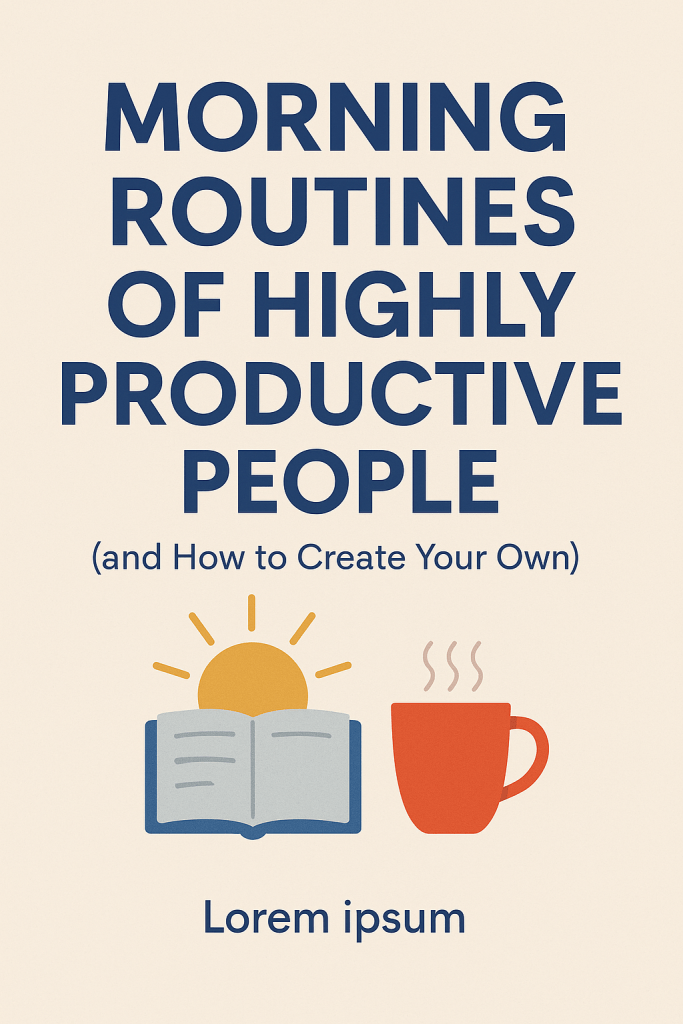
Spoiler: you don’t need a 4 a.m. wake-up, an ice bath, or a monk-like schedule.
You need a short, repeatable set of actions that protects your energy, removes noise, and points you at the right work—every single morning.
TL;DR (What Highly Productive Mornings Actually Do)
- Protect attention: no reactive inputs first thing (email, social media, news).
- Prime the body: hydrate and do light movement to switch on energy.
- Set intention: a 60-second plan beats an hour of drifting.
- Start real work fast: one focused block on your most important task.
Why Mornings Matter (Backed by Behavioral Science)
- Decision fatigue is lowest early. Fewer choices = easier follow-through.
- Identity cues are strong. What you do first tells your brain, “I’m the kind of person who…”
- Momentum compounds. A single early win (bed made, water drunk, page written) increases the probability of a second win.
What Highly Productive People Actually Do (Common Patterns)
You’ll see different flavors, but the building blocks repeat:
- Wake + Water (1–2 min)
A full glass rehydrates after sleep, improves alertness, and pairs well with vitamins/meds. - Light Movement (5–10 min)
Stretching, mobility, a walk, or a quick bodyweight circuit—just enough to raise heart rate. - Quiet Mind (3–10 min)
Breathwork, prayer, meditation, or journaling—a short reset that reduces mental noise. - Plan the Day (2–5 min)
Write your top 3 outcomes. Not tasks—outcomes (“Send client proposal,” not “open doc”). - Deep Work First (25–60 min)
A distraction-free sprint on your #1 outcome before the world asks for anything. - Fuel (5–15 min)
Protein-forward breakfast or coffee after the deep-work start (so caffeine is paired with action, not doomscrolling).
Notice what’s missing: notifications. The most productive people delay reactive inputs until after their focus block.
The 5 Rules of a Great Morning Routine
- Keep it short. 20–60 minutes total is plenty.
- Sequence beats duration. Do the same steps in the same order.
- Make it visible. Put your steps on a card/phone widget.
- Anchor to existing habits. (After I brush teeth → drink water.)
- Start tiny. Two minutes of movement is greater than zero minutes of perfection.
A Simple, High-Performance Morning Template
| Step | Action | Target Time |
|---|---|---|
| 1 | Wake up and drink one full glass of water | 2 min |
| 2 | Light movement (mobility flow or brisk walk) | 8–10 min |
| 3 | Quiet mind (breathe 4-7-8 or 5 min meditation) | 5 min |
| 4 | Plan: write your Top 3 outcomes | 3 min |
| 5 | Deep Work Sprint on #1 (no phone, no email) | 25–50 min |
| 6 | Coffee/breakfast, then messages | 10–15 min |
Pro tip: If time is tight, do Steps 1–4 (≈18 minutes) and schedule the sprint later in the morning.
Three Proven “Style Presets” (Pick One to Start)
1) The Creative Sprint
- Water → 5 min breath → 30–45 min drafting/ideation
- No research during the sprint—create first, refine later.
2) The Executive Start
- 7-minute mobility → Top 3 outcomes → 25-minute “decision block” (approve, delegate, schedule)
- Saves hours of asynchronous ping-pong later.
3) The Wellness First
- 10-minute walk in daylight → protein breakfast → Top 3 → 25-minute deep work
- Great for energy-sensitive or anxious mornings.
How to Design Your Routine in 10 Minutes
- Pick a primary goal: energy, focus, creativity, or calm.
- Choose 3 building blocks that support that goal (from the patterns above).
- Write your 6-line routine card (example below).
- Place your cues: water on the nightstand, shoes by the door, and notebook open.
- Commit to 7 days. Assess, then adjust.
Example routine card (copy/paste):
- Water (1 glass)
- 8-minute mobility
- 5-minute breathe/journal
- Write the top 3 outcomes
- 30-minute Deep Work Sprint
- Coffee + messages
Common Roadblocks (and Friction-Free Fixes)
- “I don’t have time.” Run the 10-minute version: water → 3 min breath → write top 3 → 5-min micro-sprint.
- “Kids/household interruptions.” Do a silent prep the night before; shift deep work to after school drop-off.
- “I always grab my phone.” Charge in another room; use a $10 kitchen timer for sprints.
- “I fall off on travel or busy weeks.” Keep a 3-step travel routine (water → stretch → Top 1) and call it a win.
- “I wake up groggy.” Get morning light (window or quick walk) and hydrate before coffee.
Turn Routine Into Habit (So It Sticks)
- Implementation intention: “At 7:00 a.m., in the kitchen, I will write my Top 3.”
- Habit stacking: After coffee starts → 5 pushups + 30-second plank.
- Environment design: Clear desk nightly; put Deep Work materials out.
- An accountability cue: Leave your filled-in Top 3 on the keyboard.
Two-Minute Starters (When Motivation Is Zero)
- Put on workout clothes.
- Write one sentence.
- Open the calendar and block a 25-minute sprint.
- Breathe: inhale 4, hold 7, exhale 8 (repeat 3x).
- Make the bed (micro-win triggers momentum).
The One-Week Morning Reset (Follow This Plan)
Day 1 (Mon): Write a routine card; do water + top 3 + 25-min sprint.
Day 2: Add 5–8 min of movement.
Day 3: Add 3–5 min of quiet mind.
Day 4: Push sprint to 35–45 min if it felt easy.
Day 5: Delay phone/email until after the sprint.
Day 6: Night-before prep: clear desk, set out water/glass.
Day 7: Review: keep what worked, drop what didn’t, and plan next week.
Frequently Asked Questions
Q: What time should I wake up?
A: The time that lets you get 7–9 hours of sleep and complete a short, consistent routine. Consistency beats ultra-early.
Q: Coffee before or after deep work?
A: If you’re prone to anxious scrolling, pair coffee after your first sprint to reward action.
Q: How long should the routine be?
A: 20–60 minutes on typical days; a 10-minute compression for busy days.
Q: Can I check my phone when I wake up?
A: Use airplane/DND until your plan and first action are done. Protect the first 30–60 minutes.
SEO Cheat Sheet (for Your Blog Post)
- Target keywords: morning routine, productive morning routine, how to create a morning routine, morning habits, deep work morning.
- Title tag (≤60 chars): Morning Routines of Highly Productive People (+ How to Build Yours)
- Meta description (≤155 chars): Steal the patterns of top performers and build a 20–60 min morning routine that boosts energy, focus, and results—without waking at 4 a.m.
- Suggested slug:
/morning-routines-productive-people
Copy-and-Keep Checklist
- ☐ Water ready at bedside
- ☐ Timer on desk (not phone)
- ☐ Routine card visible
- ☐ Desk cleared the night before
- ☐ Top 3 written before opening inbox
- ☐ 25–50 min Deep Work Sprint scheduled
Final Word
A great morning routine isn’t a performance—it’s a system. Keep it short, make it obvious, and repeat it until it runs on rails. Your day (and results) will follow.





Leave a comment